Upper Blepharoplasty
qd upper blepharoplasty
Upper blepharoplasty adjusts excess upper-eyelid skin to address a heavy appearance. Brow descent and eyelid-opening strength are assessed separately; skin removal alone does not correct every case of ptosis. The natural crease guides incision planning.
Upper Blepharoplasty is available at QD Clinic in Gangnam, Seoul, Korea.

is this for me
Who it’s for
Even if none of these describes you, we will look again at the consultation.
- Excess or hooding upper-eyelid skin that rests on the lashes
- A heavy, tired upper-eye look, often with age
- Skin that can interfere with the line of the eye or with eye makeup
If your main goal is to create or reshape a crease, double eyelid surgery may suit better; the right plan is decided at consultation.
start with your concern
Before you pick a treatment name, start with the cause of your concern.
Even a treatment with the same name takes on a different role and scope depending on your current structure, the change you want, what you have had before and the recovery time you have.
Where you are now, and where we start
Drooping upper eyelid skin, fat and the ability to open the eye
The change you want, the impression you keep
If your main goal is to create or reshape a crease, double eyelid surgery may suit better; the right plan is decided at consultation.
How it differs from similar options
These procedures address the upper eye differently, so the right one depends on your goal — removing skin, forming a crease, or lifting the brow. This is not a ranking.
Health information and recovery schedule
Performed under local anesthesia, sometimes with light sedation; you can usually go home the same day. Fine sutures in the crease are typically removed at about 5–7 days, unless dissolvable sutures are used. Expect temporary swelling and possible bruising, with much of it easing within about 1–2 weeks; cold compresses and head elevation help. Side effects such as swelling, bruising, asymmetry, tightness or temporary dryness may occur and are explained at consultation.
the principle
How it works
Alongside shape, we examine how the eye opens and closes, the ocular surface, the fat, skin and adhesions, then set the incision and the extent of correction.
Upper blepharoplasty adjusts excess upper-eyelid skin to address a heavy appearance. Brow descent and eyelid-opening strength are assessed separately; skin removal alone does not correct every case of ptosis. The natural crease guides incision planning. Upper blepharoplasty uses a skin incision planned around the natural upper-lid crease. A red line or firmness may remain initially and can fade as healing progresses, but a scar-free result cannot be promised. This differs from the transconjunctival approach used for some lower-lid procedures.
How it works
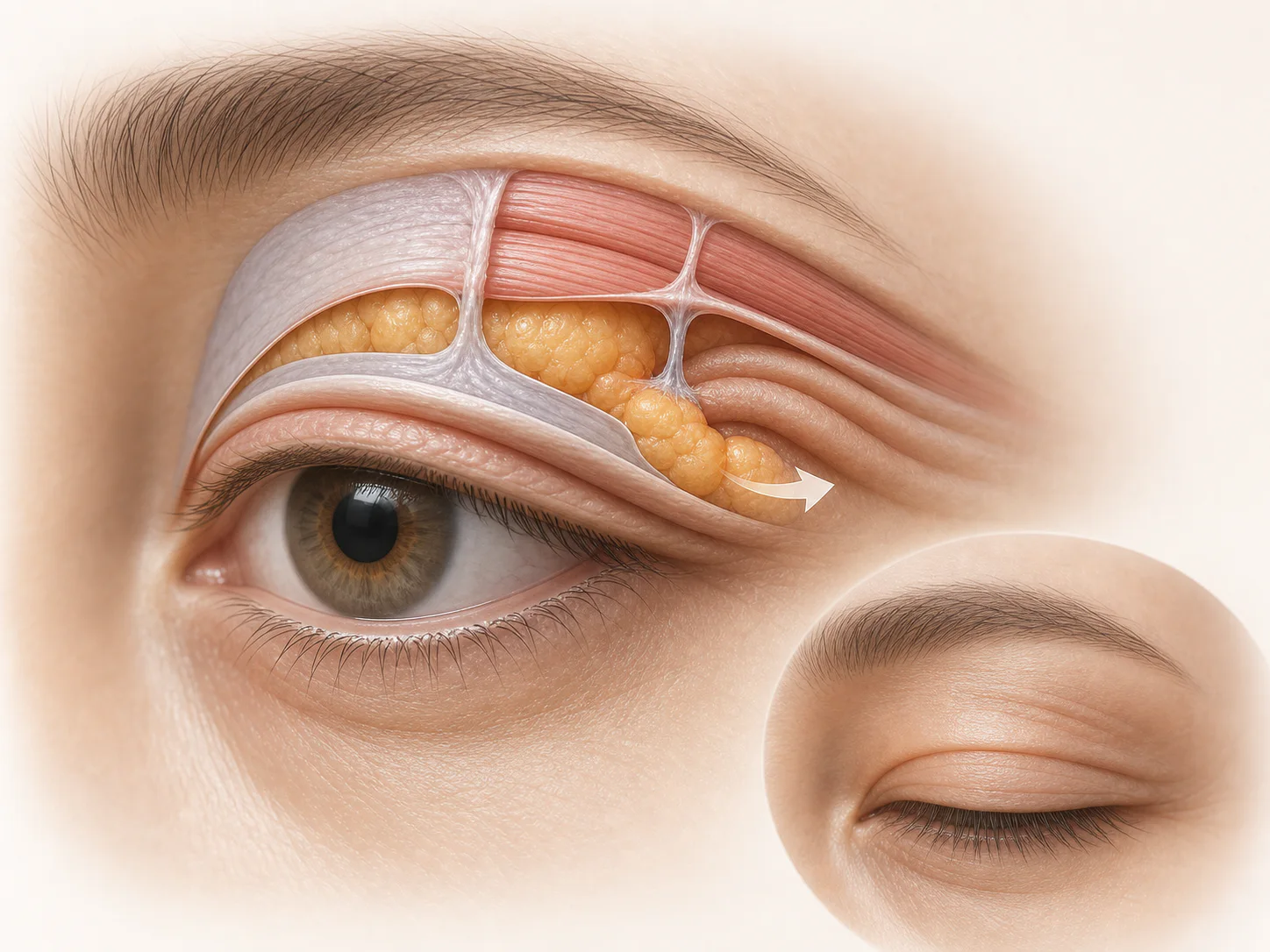
A measured strip of skin is removed
The surgeon marks the natural crease and removes a measured strip of hooding upper-lid skin through an incision placed in that fold.
The incision hides in the crease
Upper blepharoplasty uses a skin incision planned around the natural upper-lid crease. A red line or firmness may remain initially and can fade as healing progresses, but a scar-free result cannot be promised. This differs from the transconjunctival approach used for some lower-lid procedures.
Muscle or fat lightened if needed
A thin strip of orbicularis muscle or a small amount of puffy fat may also be reduced to lighten a heavy lid.
Local anesthesia, fine closure
It is performed under local anesthesia, sometimes with light sedation, and closed with fine sutures within the crease. This differs from double eyelid surgery, which is chosen mainly to form a crease.
the qd standard
The same treatment, never the same plan.
Rather than a fashionable name or a fixed package, we weigh the structure found at examination, safety, recovery and the limits within one plan.
- DIAGNOSIS FIRST
Cause before name
We first separate out the tissue and the function behind your concern.
- LESS, PRECISE
Only as much as needed
Rather than an excessive change, we plan the smallest scope with a clear role.
- HONEST LIMIT
The limits, explained too
We explain the change you can expect, the alternatives, individual differences and the risks.
personal plan
From consultation to follow-up, planned as one flow.
Upper blepharoplasty adjusts excess upper-eyelid skin to address a heavy appearance. Brow descent and eyelid-opening strength are assessed separately; skin removal alone does not correct every case of ptosis. The natural crease guides incision planning.


Anatomy and function exam
Consultation, eye assessment and design of the crease line
Comparing scope and method
These procedures address the upper eye differently, so the right one depends on your goal — removing skin, forming a crease, or lifting the brow. This is not a ranking.
Surgery and recovery plan
This is usually a single procedure. Early swelling settles over about 1–2 weeks and the crease line continues to soften and settle over a few months. (Results vary by individual.)
What the procedure is like
- Consultation, eye assessment and design of the crease line
- Local anesthesia (with optional light sedation)
- Incision within the natural upper-lid crease
- Removal of the measured excess skin, with muscle or fat adjusted as needed
- Suture closure within the crease, recovery and aftercare guidance
Time: The procedure takes about 40–60 minutes.
Please read this before treatment
- Performed under local anesthesia, sometimes with light sedation; you can usually go home the same day.
- Fine sutures in the crease are typically removed at about 5–7 days, unless dissolvable sutures are used.
- Expect temporary swelling and possible bruising, with much of it easing within about 1–2 weeks; cold compresses and head elevation help.
- Side effects such as swelling, bruising, asymmetry, tightness or temporary dryness may occur and are explained at consultation.
Safety & considerations
Possible reactions
- Temporary swelling and bruising around the upper lids
- Asymmetry between the two sides, or an uneven crease height
- Tightness or brief difficulty closing the eyes fully early on
- Temporary dryness or irritation
- Scarring; the incision is placed within the crease to be discreet
When to take extra care
- Bleeding disorders or blood-thinning medication — tell your doctor
- A history of significant dry eye or thyroid eye disease
- A tendency to keloid or difficulty with wound healing
- Smoking, which can affect healing
- If your main goal is a defined crease, or a revision after previous eyelid surgery
Risks include bleeding, infection, scarring, asymmetry, difficulty closing the eyes, dry eyes, changes in upper-lid height or crease and possible revision. Sudden visual change, severe eye pain or rapidly increasing swelling require urgent medical care.
what to expect
What to expect over time
A general guide to how the days and months after treatment usually unfold. Results vary by individual.
DAY 0
Surgery day
Performed under local anesthesia, sometimes with light sedation; you usually go home the same day with mild tightness across the upper lids.
DAY 1-3
Swelling & bruising
Swelling and possible bruising are usually most noticeable now; cold compresses and keeping the head elevated help.
DAY 5-7
Suture removal
Fine sutures in the crease are typically removed at about 5–7 days, unless dissolvable sutures are used.
WEEK 1-2
Settling
Much of the visible swelling and bruising eases over one to two weeks, though the lid can feel tight for a while.
1-3 MONTHS
Crease settles
The healing line continues to soften and settle over a few months. (Results vary by individual.)
Sessions & results
This is usually a single procedure. Early swelling settles over about 1–2 weeks and the crease line continues to soften and settle over a few months. (Results vary by individual.)
how it compares
How it compares
These procedures address the upper eye differently, so the right one depends on your goal — removing skin, forming a crease, or lifting the brow. This is not a ranking.
| Upper Blepharoplasty | Brow lift | |
|---|---|---|
| Approach | Removes excess hooding skin via a crease incision | Repositions a descended brow to lift the upper eye |
| Best for | Excess, sagging upper-lid skin | Heaviness from a low or dropped brow |
| Anesthesia | Local, sometimes with light sedation | Local with sedation, depending on method |
| Recovery | Sutures ~5–7 days; swelling ~1–2 weeks | Varies by method |
| Longevity | Long-lasting; aging continues | Long-lasting; aging continues |
Neither is “better” — they work differently and suit different goals. The right choice is decided after we assess your skin.
before consultation
Before you decide, the questions people always ask
A crease often appears on its own as the excess skin is trimmed away, but the approach is not the same as surgery whose whole purpose is to create a double eyelid. We need to settle beforehand whether you want a visible crease at all and, if you do, how high it should sit. During the consultation we work out the look you have in mind in concrete terms.
Upper blepharoplasty uses a skin incision planned around the natural upper-lid crease. A red line or firmness may remain initially and can fade as healing progresses, but a scar-free result cannot be promised. This differs from the transconjunctival approach used for some lower-lid procedures.
Removing too much skin can make the eyes harder to close or change your expression, so we decide carefully how much to leave. Taking too little can be refined later, but skin that has already been taken is difficult to put back. That is why we work conservatively as a matter of principle.
The early swelling subsides considerably over one to two weeks, but looking natural takes several months. The height of the crease in particular keeps settling as time passes, so please do not judge the result by how it looks in the first weeks. We tell you in advance that in the days right after surgery the line normally looks higher and thicker than it really is.
Your general health and the condition of your eyelids matter more than your age. When the skin hangs far enough to block your field of vision, the aim of the surgery becomes reducing an everyday inconvenience. We check for high blood pressure, diabetes, the medicines you take and any underlying conditions before deciding whether to operate and by what method.
Look at the examination and the plan rather than the treatment name. First, what the clinic checks before deciding — at QD Clinic in Gangnam, Seoul, the first thing we look at for this treatment is “Drooping upper eyelid skin, fat and the ability to open the eye”. Second, whether it explains why it recommends that scope and method, compared with the alternatives. Third, whether it reviews your progress with you when results are expected. Our doctor goes through these three points at consultation before the treatment is decided.
At QD Clinic in Gangnam, Seoul, South Korea. We are at 3F, 502 Gangnam-daero, Gangnam-gu, Seoul (Nonhyeon-dong, Seohee Building), a 4-minute walk from Exit 3 of Nonhyeon or Sinnonhyeon Station. Call +82-2-514-1650 or use the consultation form on this site to book a doctor’s consultation first.
Related treatments
 Surgery
Erbium Under-Eye Fat Repositioning
qd erbium under-eye fat repositioningUnder-eye fat repositioning treats eye bags by moving the fat that bulges under the eye down into the hollow of the tear trough, smoothing the transition between the lid and cheek. At QD Clinic in Gangnam, Seoul, this is performed through the inside of the lower eyelid (transconjunctival) using an erbium laser rather than a blade, so there is no external skin incision. It is carried out under local anesthesia. (Results vary by individual.) Surgery
Erbium + Eye Ultherapy
Combines consultation for Erbium fat repositioning and Eye Ultherapy. The need, treatment area and timing of surgery and ultrasound are assessed separately. Surgery
Erbium + Eye Thermage
Combines consultation for Erbium fat repositioning and Eye Thermage. Fat bulges and skin concerns guide radiofrequency planning and eye protection. Surgery
Erbium + Eye Sofwave
Combines consultation for Erbium fat repositioning and Eye Sofwave. Anatomy, skin condition and wound healing guide suitability and timing. Surgery
Erbium Lower Blepharoplasty
qd erbium lower blepharoplastyErbium lower blepharoplasty assesses excess lower-eyelid skin and protruding fat together. An incision below the lashes allows skin adjustment and, when appropriate, fat repositioning or conservative reduction. Eyelid support and dry eyes guide the extent. Surgery
Revision Eyelid Surgery
qd Revision Eyelid SurgeryPrevious surgery, crease changes, scars and closure difficulties are assessed by cause. Remaining tissue and adhesions determine the possibilities and limits of revision.

personal consultation
Tell us what bothers you now, the change you want, what you have had done before and any dates that matter. We will compare the possible approaches and their limits, calmly.
Consult now