TA Inflammation Injection
TA inflammation injection uses a triamcinolone corticosteroid locally when a clinician considers a lesion suitable. Its depth, location and previous injection history are reviewed one lesion at a time, separately from comedone extraction.
TA Inflammation Injection is available at QD Clinic in Gangnam, Seoul, Korea.


is this for me
Who it’s for
Even if none of these describes you, we will look again at the consultation.
- People with a painful, red individual acne lesion
- Those asking about a repeatedly inflamed spot
- People unsure whether a lesion needs extraction or medical treatment
Not every bump is suitable for injection. Suspected infection or another skin condition needs diagnosis first.
start with your concern
Before you pick a treatment name, start with the cause of your concern.
Even a treatment with the same name takes on a different role and scope depending on your current structure, the change you want, what you have had before and the recovery time you have.
Where you are now, and where we start
Medical assessment and a local injection for an individual painful inflammatory lesion
The change you want, the impression you keep
Only lesions judged suitable at assessment are treated. Reassess whether the diagnosis has changed.
How it differs from similar options
TA addresses selected local inflammation; extraction mechanically removes suitable comedonal contents.
Health information and recovery schedule
Dates and responses of prior steroid injections at that site · Drug allergy, diabetes control and current infection
the principle
How it works
TA Inflammation Injection
Triamcinolone is a corticosteroid used to reduce local inflammation. Concentration and amount follow lesion type, depth and skin thickness. Excessive or repeated local treatment can cause indentation or pigment change; it does not address every cause of recurring facial acne.
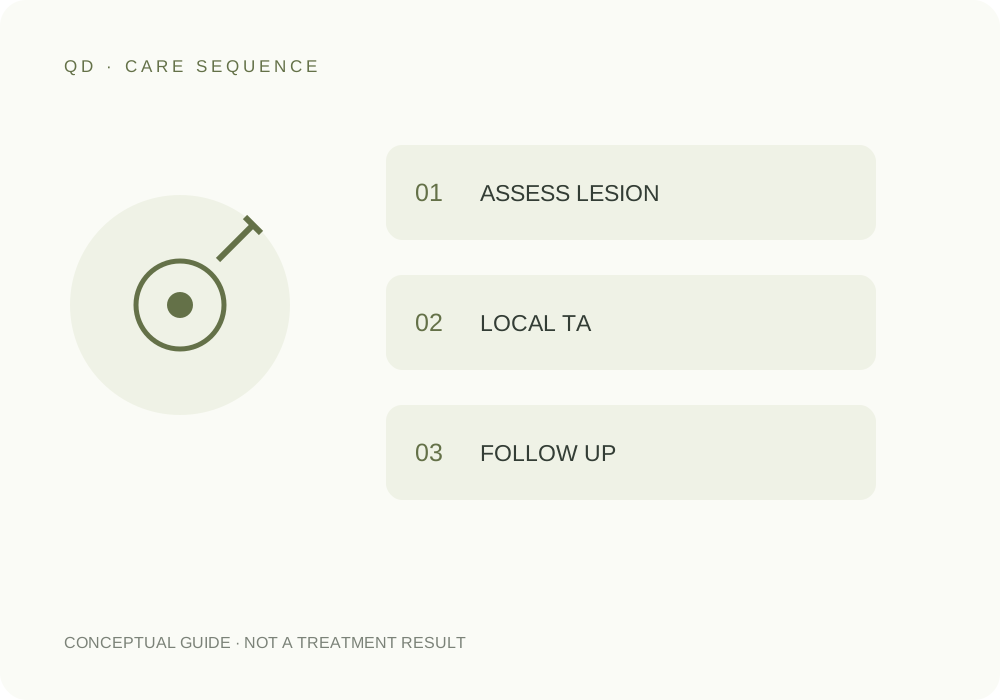
How it works
Diagnose the lesion
Distinguish a comedone from an inflammatory nodule or infection.
Check prior injections
Record the substance, date and any previous indentation.
Plan local treatment
The clinician selects an appropriate amount for the lesion.
Observe skin changes
Review delayed indentation or lightening as well as redness.
the qd standard
The same treatment, never the same plan.
Rather than a fashionable name or a fixed package, we weigh the structure found at examination, safety, recovery and the limits within one plan.
- DIAGNOSIS FIRST
Cause before name
We first separate out the tissue and the function behind your concern.
- LESS, PRECISE
Only as much as needed
Rather than an excessive change, we plan the smallest scope with a clear role.
- HONEST LIMIT
The limits, explained too
We explain the change you can expect, the alternatives, individual differences and the risks.
personal plan
From consultation to follow-up, planned as one flow.


Classify before injecting
Keep injection indications separate from extraction indications.
Record repeat treatment
Check cumulative treatment at the same location.
Review delayed changes
Reduced inflammation alone is not the only outcome to assess.
What the procedure is like
- Check lesion depth, size and previous injections at the same site.
- The clinician explains the plan, cleans the site and gives the local injection.
- Explain how to watch for indentation, colour changes and recurrence.
The injection itself may be brief; assessment and the number of lesions affect the visit.
Please read this before treatment
- Do not squeeze or strongly massage the injected lesion.
- Report a developing dent or lighter patch, including changes noticed later.
Safety & considerations
Possible reactions
- Injection discomfort, bruising or occasional infection
- Local atrophy, indentation, pigment change or visible small vessels
Review before care
- Dates and responses of prior steroid injections at that site
- Drug allergy, diabetes control and current infection
A clinician must inspect the lesion to decide whether TA is appropriate.
what to expect
What to expect over time
A general guide to how the days and months after treatment usually unfold. Results vary by individual.
Before injection
Record tenderness, appearance and previous treatment.
Early review
Observe redness and tenderness rather than expecting a fixed response time.
Later review
Check for indentation, colour change or recurrence at the same site.
Sessions & results
Response varies. A recurring spot should be reassessed rather than automatically injected again immediately.
how it compares
How it compares
TA addresses selected local inflammation; extraction mechanically removes suitable comedonal contents.
| TA Inflammation Injection | Comedone Extraction | |
|---|---|---|
| Scope and purpose | Clinician-selected local medicine for an inflammatory lesion | Physical removal of suitable blocked pore contents |
before consultation
Before you decide, the questions people always ask
TA generally refers to triamcinolone acetonide, a corticosteroid. Unlike an antibiotic, it is not used to kill bacteria but to reduce a local inflammatory reaction. A lesion with suspected infection is diagnosed before any injection is considered, and the clinician confirms the actual medicine and its purpose.
Frequent repeat treatment can increase local complications such as indentation. Previous timing and response must be reviewed first. If the spot swells again, it is reassessed as a simple recurrence or a different lesion rather than injected again straight away.
Record when it appeared and contact the clinic with a photograph, as it may reflect local skin atrophy. Do not try to correct it by massage or another injection on your own. Please also mention any lightening of colour or visible small vessels in the same area.
A minimally inflamed comedone may need a different approach. Colour alone cannot establish the diagnosis; the lesion should be examined. A comedone whose contents can be removed may be better suited to extraction, while TA is used for red, painful inflammatory lesions the clinician judges appropriate.
It refers to the lesion being treated. Confirm the lesion count and method at assessment; this is separate from full-face care. The clinician sets the concentration and amount according to the lesion’s size, depth and skin thickness.
Related treatments
 Skincare
Aqua Peel Basic
qd aqua peel basicWhether the goal is clearing debris and dead skin from pore openings, and whether your skin stays calm rather than heating up afterwards Skincare
Aqua Peel Premium
qd aqua peel premiumWhether skin that heats up after exfoliation needs cooling with cryo, and whether you are sensitive to cold Skincare
Black Peel
qd black peelWhether your acne is at the comedone stage or the red, inflamed stage, and whether extraction is also needed Skincare
Pink Peel
qd pink peelWhether you want smoother texture or firmness care, and whether acids sting your skin a lot Skincare
YES Peel
qd yes peelWhether sensitivity comes from inflammation or a weakened barrier, and any upcoming events or other treatment plans Skincare
LaLa Peel
qd lala peelWhether your skin is oily yet stings easily, and whether irritation from peeling needs to be kept down

personal consultation
Tell us what bothers you now, the change you want, what you have had done before and any dates that matter. We will compare the possible approaches and their limits, calmly.
Consult now