PDT
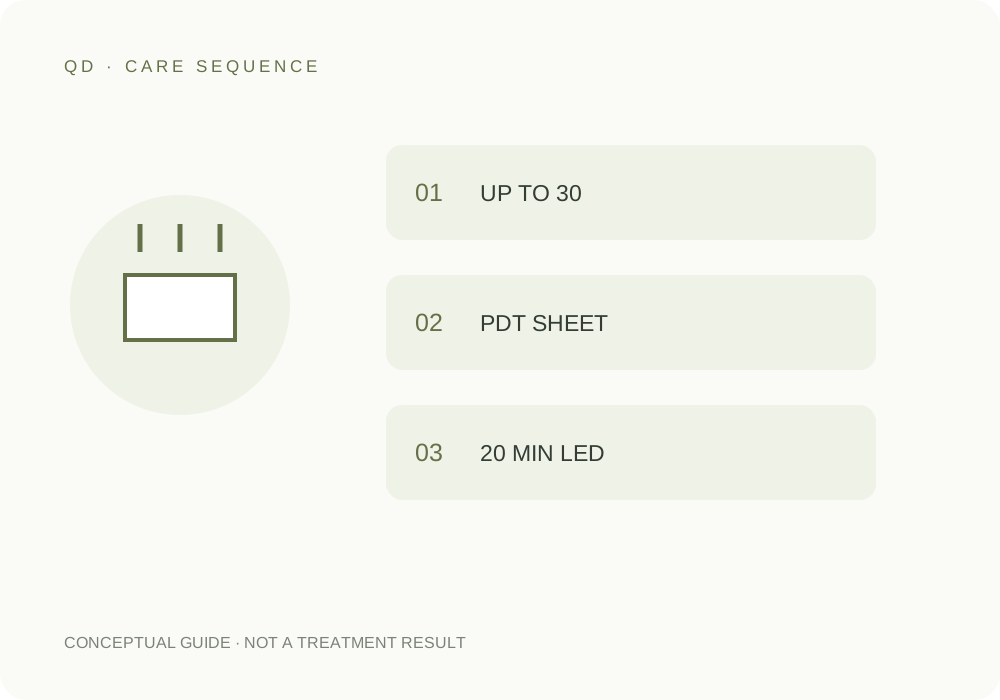
The QD PDT menu includes extraction of up to 30 suitable lesions, a PDT sheet and 20 minutes of LED. We assess comedones and inflammatory spots, then confirm the sheet’s actual ingredients and light-related precautions.
PDT is available at QD Clinic in Gangnam, Seoul, Korea.


is this for me
Who it’s for
Even if none of these describes you, we will look again at the consultation.
- People seeking assessment of comedones and recurring inflammation
- Those comparing extraction with light-based care
- People planning treatment around outdoor activities
The name PDT does not identify a particular photosensitiser, concentration or wavelength. The actual product and method must be confirmed.
start with your concern
Before you pick a treatment name, start with the cause of your concern.
Even a treatment with the same name takes on a different role and scope depending on your current structure, the change you want, what you have had before and the recovery time you have.
Where you are now, and where we start
Up to 30 extractions, a PDT sheet and 20 minutes of LED, with product-specific light precautions
The change you want, the impression you keep
Prioritise suitable lesions within the maximum of 30. Deep nodules may require a separate treatment plan.
How it differs from similar options
PDT centres on the sheet and light step; Basic Acne Care also includes a selected peel and LDM.
Health information and recovery schedule
Photosensitivity conditions and medicines · Recent intense sun exposure, pregnancy, breastfeeding or infection
the principle
How it works
PDT
Photodynamic therapy generally combines a light-reactive substance with a light source. This menu specifies a PDT sheet and LED; it should not be assumed equivalent to a particular medicinal PDT protocol without verifying the product. Lesion selection and a photosensitivity review come first.
How it works
Select lesions
Separate extractable comedones from deeper inflamed lesions.
Check the sheet
Identify light-reactive ingredients and contact allergies.
Twenty-minute LED
Use eye protection and monitor heat or stinging.
Plan light exposure
Match outdoor precautions to the actual preparation used.
the qd standard
The same treatment, never the same plan.
Rather than a fashionable name or a fixed package, we weigh the structure found at examination, safety, recovery and the limits within one plan.
- DIAGNOSIS FIRST
Cause before name
We first separate out the tissue and the function behind your concern.
- LESS, PRECISE
Only as much as needed
Rather than an excessive change, we plan the smallest scope with a clear role.
- HONEST LIMIT
The limits, explained too
We explain the change you can expect, the alternatives, individual differences and the risks.
personal plan
From consultation to follow-up, planned as one flow.


Explain the preparation
Confirm the sheet and its light-response method.
Prioritise suitable extraction
Do not force difficult lesions simply to reach the maximum count.
Coordinate outdoor plans
Discuss planned outdoor work or photography before treatment.
What the procedure is like
- Review medicines, photosensitivity conditions and recent sunlight exposure.
- Extract up to 30 suitable lesions and apply the PDT sheet.
- Use eye protection during 20 minutes of LED and give product-specific aftercare.
The LED step is 20 minutes; assessment, extraction and sheet preparation take additional time.
Please read this before treatment
- Use gentle cleansing and moisturising if redness, flaking or warmth develops.
- When a photosensitiser is used, restrict sunlight for the period advised for that product.
Safety & considerations
Possible reactions
- Temporary redness, stinging or flaking
- Photosensitive reactions, pigment changes or occasional blistering
Review before care
- Photosensitivity conditions and medicines
- Recent intense sun exposure, pregnancy, breastfeeding or infection
Report marked pain, blisters or spreading redness. Light avoidance must follow the actual product’s instructions.
what to expect
What to expect over time
A general guide to how the days and months after treatment usually unfold. Results vary by individual.
Before treatment
Review outdoor plans and medicines affecting light sensitivity.
Immediately afterward
Distinguish extraction marks from light-related irritation.
Reassessment
Track existing spots and the frequency of new inflammation.
Sessions & results
One- and three-session options are available. Repetition and spacing depend on the product and response; medicines or ongoing acne care may still be necessary.
how it compares
How it compares
PDT centres on the sheet and light step; Basic Acne Care also includes a selected peel and LDM.
| PDT | Basic Acne Care | |
|---|---|---|
| Scope and purpose | Up to 30 extractions, PDT sheet and 20-minute LED | Selected peel, 10 extractions, LDM acne mode, LED and mask |
before consultation
Before you decide, the questions people always ask
No. The actual preparation determines whether ALA or another light-reactive ingredient is present and at what concentration. Similar menu names can describe different methods.
Thirty is a maximum, not a target. Fewer may be appropriate, while deep inflamed lesions need separate assessment. Difficult lesions are not forced simply to reach the count, and areas where comedones cluster are prioritised instead.
No. Twenty minutes describes the LED stage. Assessment, extraction and any sheet application or preparation require separate time.
Check the actual product’s photosensitivity advice first. If you cannot avoid sunlight as required, rescheduling may be appropriate. Redness, flaking or warmth can also develop afterwards, so consider how your skin may look on the day of the shoot.
Do not independently change prescribed treatment. Discuss the plan with the prescriber, and mention medicines that may affect light sensitivity before the visit. Even after several PDT sessions, medication or lifestyle measures may still be needed to reduce recurrence.
Related treatments
 Skincare
Aqua Peel Basic
qd aqua peel basicWhether the goal is clearing debris and dead skin from pore openings, and whether your skin stays calm rather than heating up afterwards Skincare
Aqua Peel Premium
qd aqua peel premiumWhether skin that heats up after exfoliation needs cooling with cryo, and whether you are sensitive to cold Skincare
Black Peel
qd black peelWhether your acne is at the comedone stage or the red, inflamed stage, and whether extraction is also needed Skincare
Pink Peel
qd pink peelWhether you want smoother texture or firmness care, and whether acids sting your skin a lot Skincare
YES Peel
qd yes peelWhether sensitivity comes from inflammation or a weakened barrier, and any upcoming events or other treatment plans Skincare
LaLa Peel
qd lala peelWhether your skin is oily yet stings easily, and whether irritation from peeling needs to be kept down

personal consultation
Tell us what bothers you now, the change you want, what you have had done before and any dates that matter. We will compare the possible approaches and their limits, calmly.
Consult now