Jaw Botox 50u
qd masseter botox
Jaw Botox 50u is a treatment in which 50 units of botulinum toxin are injected into the chewing muscle (masseter), which hardens at the side of the jaw when you clench your back teeth. As the muscle is used less and gradually thins, the angular line of the lower face can soften. Before injecting, QD Clinic asks you to clench your teeth and first checks by touch whether the width comes from the muscle.
Jaw Botox 50u is available at QD Clinic in Gangnam, Seoul, Korea.


is this for me
Who it’s for
Even if none of these describes you, we will look again at the consultation.
- The muscle at the side of your jaw stands out firmly when you clench
- Your lower face looks angular or wide from the front
- You’ve been told you have a habit of clenching your teeth
Jaw Botox doesn’t change the shape of the bone. For teeth grinding or jaw joint pain, dental care may need to come first.
start with your concern
Before you pick a treatment name, start with the cause of your concern.
Even a treatment with the same name takes on a different role and scope depending on your current structure, the change you want, what you have had before and the recovery time you have.
Where you are now, and where we start
Whether the reason your lower face looks wide is the thickness of the chewing muscle (masseter), or bone or fat
The change you want, the impression you keep
If the jaw looks wide because of bone, a muscle injection makes little difference, so we see how much the muscle stands out when you clench.
How it differs from similar options
If the area below the ears or under the jaw is soft and full, it may be the salivary glands rather than the muscle; in that case we discuss Salivary Gland Botox separately.
Health information and recovery schedule
If your cheeks are naturally slim, the side of the cheeks can look hollow as the muscle shrinks, so we set the dose conservatively.
the principle
How it works
Jaw Botox doesn’t dissolve the muscle — it makes it thinner by having it used less.
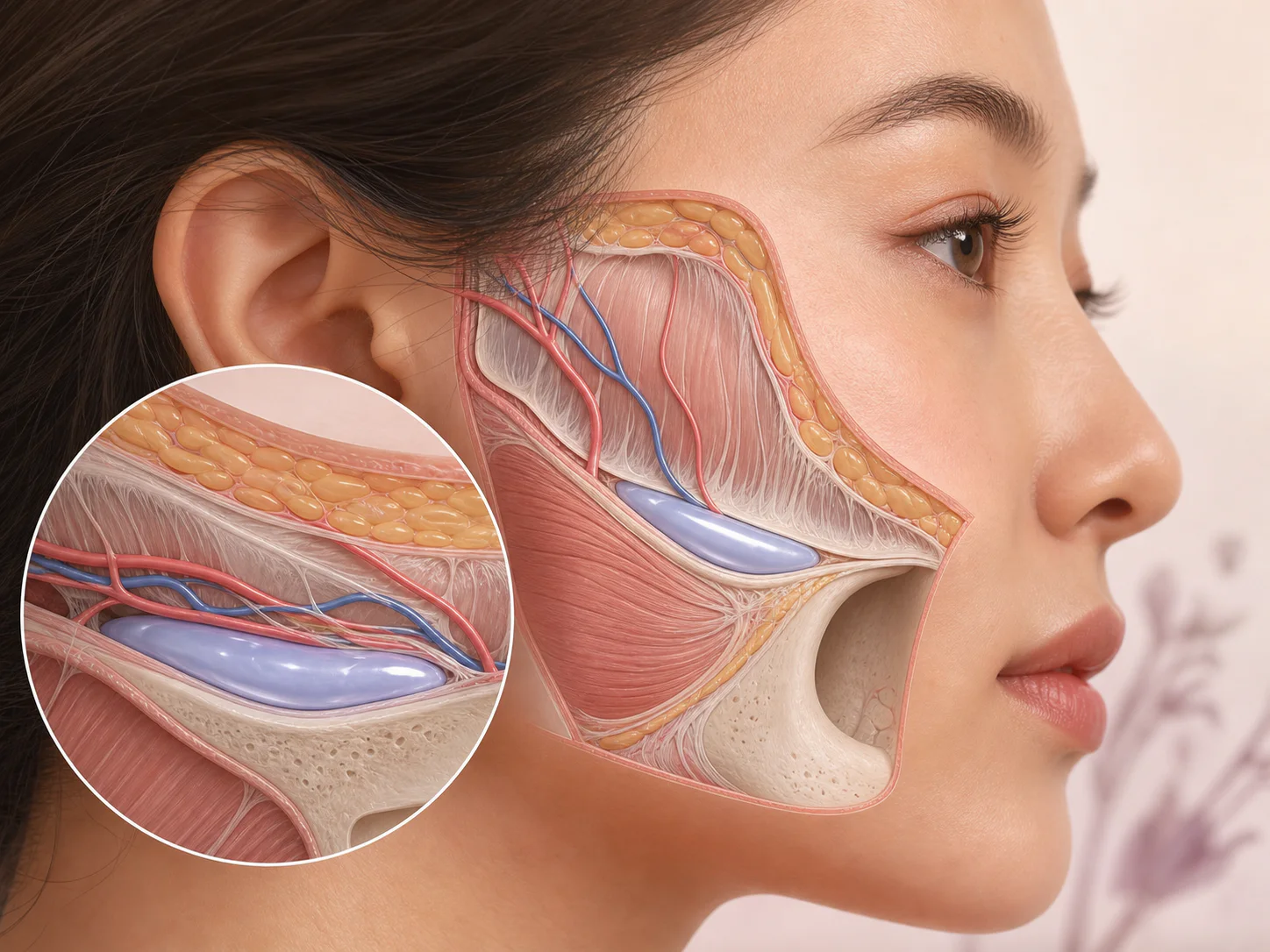
The masseter is used every time you chew food or clench your teeth, and it can thicken depending on your habits. When botulinum toxin reduces this muscle’s contraction, its thickness decreases over several weeks in proportion to how little it is used. A study that measured the masseter with 3D CT reported that muscle volume decreased and then returned to its original state at around 6 months. That is why the change shows not right after the injection but several weeks later, and maintaining it requires repeat treatment.
How it works
Feeling it while you clench
When you bite down on your back teeth, the masseter rises firmly below and in front of the ear. We confirm this area by hand and place the injection points only within the muscle.
Left–right differences
Depending on chewing habits, the muscles on the two sides can differ in thickness. If there is a difference, the amount used on each side can differ.
Avoiding the smile muscle
A muscle that pulls the corners of the mouth sideways runs in front of the masseter. If injections drift forward, your smile can change, so we mark the front boundary so it isn’t crossed.
A change that shows weeks later
Muscle thickness decreases as the period without use builds up, so it takes several weeks before you notice a difference in the mirror. Keeping photos from the same angle makes comparison easier.
the qd standard
The same treatment, never the same plan.
Rather than a fashionable name or a fixed package, we weigh the structure found at examination, safety, recovery and the limits within one plan.
- DIAGNOSIS FIRST
Cause before name
We first separate out the tissue and the function behind your concern.
- LESS, PRECISE
Only as much as needed
Rather than an excessive change, we plan the smallest scope with a clear role.
- HONEST LIMIT
The limits, explained too
We explain the change you can expect, the alternatives, individual differences and the risks.
personal plan
From consultation to follow-up, planned as one flow.
Jaw Botox 50u is a treatment in which 50 units of botulinum toxin are injected into the chewing muscle (masseter), which hardens at the side of the jaw when you clench your back teeth. As the muscle is used less and gradually thins, the angular line of the lower face can soften. Before injecting, QD Clinic asks you to clench your teeth and first checks by touch whether the width comes from the muscle.


Identifying the cause
By clenching and touch, we see whether muscle, salivary glands or bone is creating the line.
Choosing points and product
We compare muscle thickness on both sides to set the injection points, and choose the product: Korean-made, Coretox or imported.
Comparing weeks later
Several weeks later, when muscle thickness has reduced, we look at the change with photos taken from the same angle.
What the procedure is like
- Clenching check and confirming the muscle area
- Cleansing and marking the muscle boundary
- Injections divided within the muscle
- Pressure, then aftercare guidance before you leave
The injections are over quickly and you can return to your day the same day. The total time, including the examination, will be explained when you visit.
Please read this before treatment
- You can go about your day as usual on the same day.
- For the first few days, it helps to cut down on very tough food or chewing gum for long periods.
- Don’t massage the injection points firmly.
Safety & considerations
Possible reactions
- Stiffness or bruising at the injection points
- A feeling of reduced chewing strength
- Rarely, a left–right difference in the movement of the mouth corners when smiling
- A feeling that the side of the cheeks looks hollow as the muscle shrinks
Please tell us first if
- Your jaw joint clicks or hurts
- You are having orthodontic or implant treatment
- You are pregnant or breastfeeding, or have a condition affecting the junction between nerves and muscles
- You recently had Botox in another area
The larger the muscle’s share in the width, the more visible the result of Jaw Botox. If bone or fat is the cause, it may not change as much as you expect, so we check the cause first. Effect and duration vary from person to person.
what to expect
What to expect over time
A general guide to how the days and months after treatment usually unfold. Results vary by individual.
Same day to a few days
Chewing feels unfamiliar
The injection points may feel stiff, or you may feel less force when chewing tough food.
2–4 weeks
Thickness starts to reduce
As the muscle is used less, you begin to feel the side of the jaw gradually thinning.
2–3 months
Most noticeable
This is when the change shows best. (Results vary from person to person.)
About 6 months
Gradual return
As the muscle is used again, its thickness returns. If you have a clenching habit, it may return sooner.
Sessions & results
Jaw Botox is not a one-time treatment; it is maintained by repeat injections before the muscle thickness returns. The timing of the next injection is decided not by date but by whether the muscle has become firm again. (Results vary from person to person.)
how it compares
How it compares
The treatment depends on what makes the lower face look wide.
| Jaw Botox 50u | Salivary Gland Botox 50u | QD V-Cut Injection | |
|---|---|---|---|
| What it addresses | Thickness of the chewing muscle (masseter) | Volume of the parotid and submandibular glands | Fat around the jawline |
| How it feels to the touch | Rises firmly when you clench | Stays soft even when you clench, with fullness below the ears or under the jaw | Soft flesh you can pinch |
| When change shows | Over several weeks | Over several weeks | Over repeated sessions |
Sometimes two or more causes are involved, so the examination sorts out how much each contributes.
before consultation
Before you decide, the questions people always ask
Jaw Botox comes as a single option using 50 units (50u) of botulinum toxin. We look at muscle thickness and left–right differences to decide where and how to divide this amount. If chewing habits have made one side thicker than the other, the amount on each side can differ.
What decreases is the thickness of the muscle at the side of the jaw, so the change appears as a narrower-looking lower face from the front. The width of the cheekbones and bone stays the same. However, if the jaw looks wide because of bone or fat, a muscle injection makes little difference, so before injecting we ask you to clench and feel how much the muscle stands out. The change appears over several weeks and is usually most visible around 2–3 months, though the degree varies from person to person.
Some people feel less stiffness when clenching because the muscle strength is reduced. However, it is not a treatment for teeth grinding or jaw joint symptoms, so if you have pain, we also recommend seeing a dentist. Also, if you have a clenching habit, the muscle is put back to work and its thickness may return more quickly.
Most people can eat their usual meals as before. For the first few weeks, you may feel less force with foods that need a lot of chewing, like tough meat, and this feeling fades over time. For the first few days, it is more comfortable to cut down on very tough foods and long gum chewing.
If both the muscle and the salivary glands are causes, we sometimes plan them for the same day. The two treatments are injected in different places, so they are marked separately and each amount is decided separately. A part that rises firmly when you clench is treated as muscle, while fullness below the ear or under the jaw that stays soft when you clench is treated as salivary gland, and the examination first sorts out how much each contributes.
Related treatments
 Botox
Wrinkle Botox, 1 Area
qd wrinkle botox 1 areaWhich one expression line among the five areas bothers you most right now, and whether it appears only when you move your face Botox
Wrinkle Botox, 3 Areas
qd wrinkle botox 3 areasWhich three of the five areas should be combined for your expressions to look even, and the balance between muscles that pull against each other Botox
Special-Area Botox
qd special area botoxThe force pulling the mouth corners down, or how much the nostrils flare when you smile, and the surrounding muscles you use to talk and smile Botox
Salivary Gland Botox 50u
qd salivary gland botoxWhether the fullness below the ears (parotid gland) or under the jaw (submandibular gland) comes from the volume of the salivary glands, or from muscle or fat Botox
Nose Contouring Injection + Nostril Botox
qd nose contour & nostril botoxWhich part around the nose you want to refine, and whether nostril flaring when you smile is also a concern Botox
Skin Botox 1cc
qd skin botoxWhich single zone of your face is where pores, shine and fine texture concentrate

personal consultation
Tell us what bothers you now, the change you want, what you have had done before and any dates that matter. We will compare the possible approaches and their limits, calmly.
Consult now