
qd story
Thermage FLX Pain, Side Effects and Recovery Time
Published: 2026-10-12
Thermage FLX is not a treatment without pain. The manufacturer, Solta Medical, states that the most common reaction during treatment is "mild to moderate pain": each time the tip touches the skin you feel brief heat, followed by cooling. After treatment, redness (usually within 24 hours) and swelling (usually within 5 days, rarely several weeks) are common, and rarely burns, blisters or scars, irregularities of the skin surface, numbness or temporary paralysis, lumps on the neck, or darkening of the skin can occur. Most people return to daily life straight away, but enduring the heat while the intensity is raised increases the risk of burns, so the most important safety rule is to tell us right away whenever it feels hot during treatment.
At a glance
- Pain: according to the manufacturer, the most common reaction during treatment is mild to moderate pain.
- Common reactions: redness usually settles within 24 hours and swelling usually within 5 days, and can last up to several weeks.
- Rare reactions: burns, blisters, scabs and scars; surface irregularities (1 month or more); numbness and temporary paralysis (up to several weeks); lumps on the neck (1–2 weeks); darkening of the skin (several months).
- When treatment cannot be done: when you have an implanted electrical device such as a pacemaker or defibrillator.
- Results: the manufacturer explains that results appear gradually over 2–6 months after a single treatment session.
How does Thermage FLX produce heat?
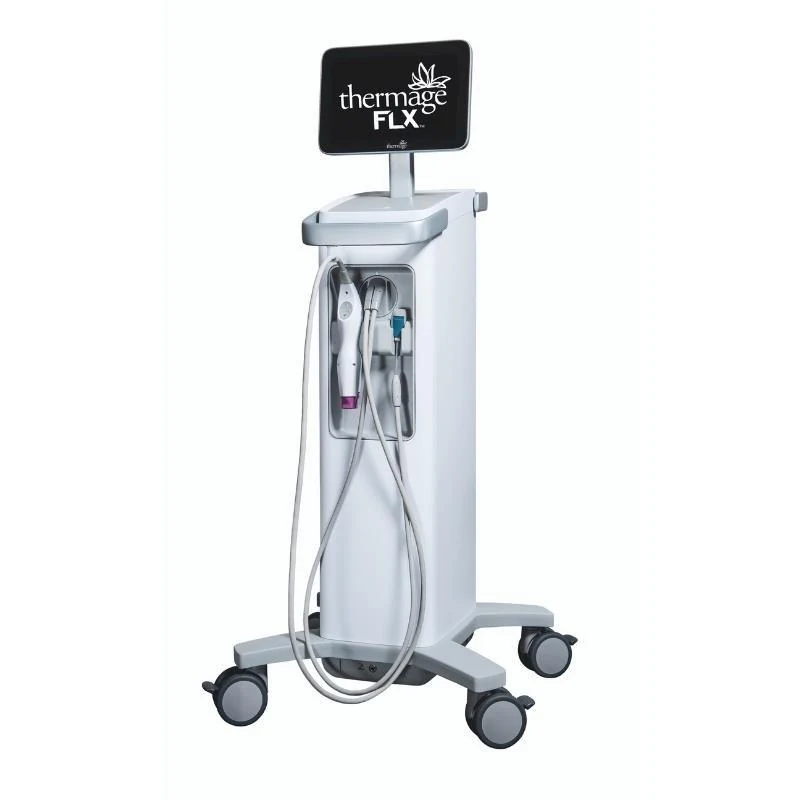
Thermage FLX is a monopolar radiofrequency (RF) device. It heats the area under the skin broadly with the heat produced as current flows through the tissue under the tip, and this heat brings about collagen changes to address wrinkles and loss of firmness. Its US FDA clearance covers non-invasive treatment of facial wrinkles and of wrinkles around the eyes, including the eyelids, among others. The handpiece combines cooling sprays and vibration, and a function called AccuREP automatically calibrates energy delivery.
Because it is a heat-based treatment, most of its pain and side effects are also related to heat. Cooling protects the surface but cannot prevent all heat injury, and vibration eases discomfort but does not remove pain.
How painful is Thermage FLX?
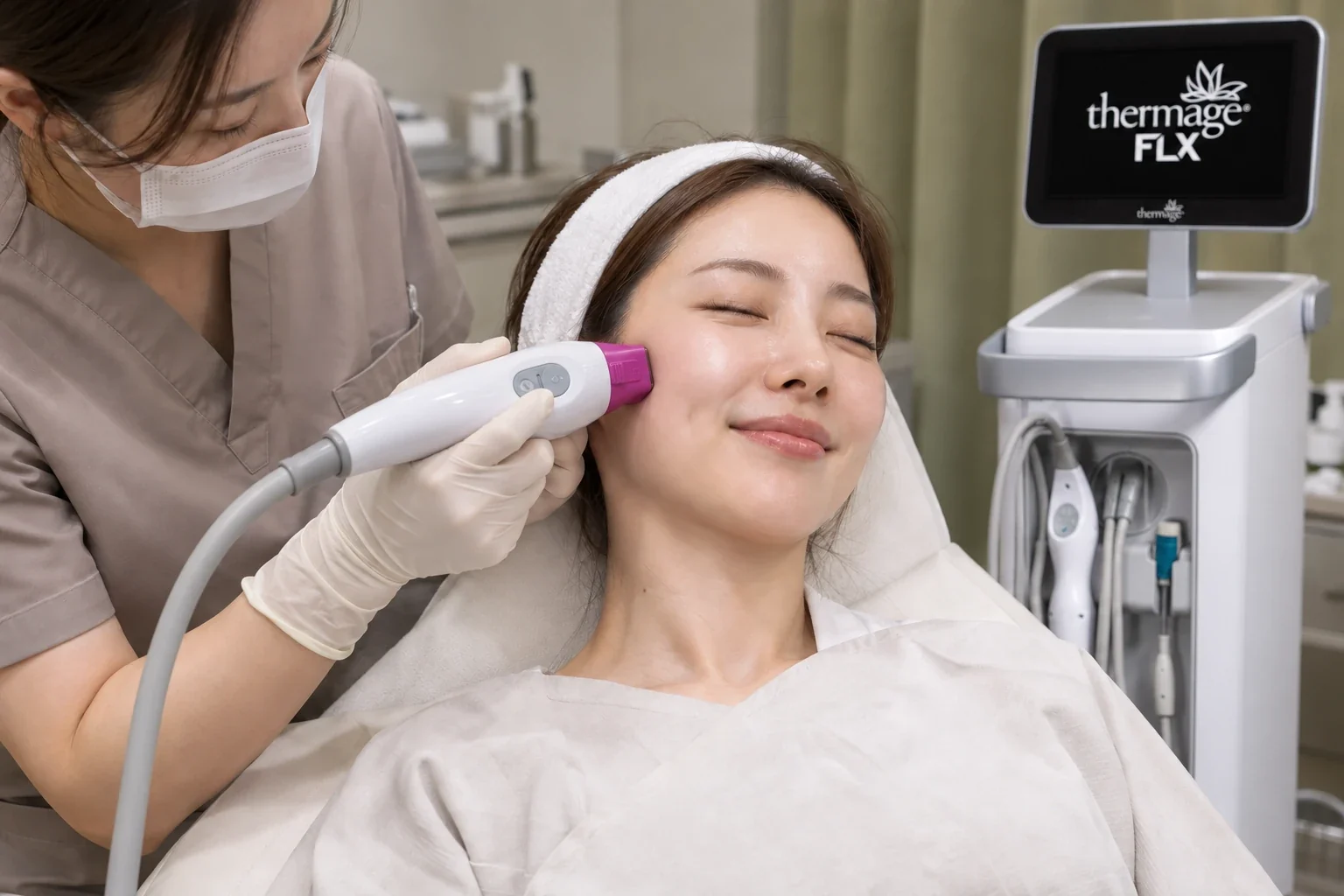
According to the manufacturer's FAQ, when the tip touches the skin you feel brief heat, followed immediately by a cooling sensation. This sensation repeats with every shot. How much it hurts differs from person to person and from area to area.
Why the energy level differs by area
Different areas of the face differ in skin thickness, the amount of fat beneath, and the distance to bone. So the same intensity is not used across the whole face; it is adjusted for each area.
Is the effect better if I endure more pain?
No. In a 2007 survey of 5,700 treatments, 45% said it was too painful with the older method of a single pass at high energy, but this fell to 5% with the method of multiple passes at lower energy, choosing the energy based on the heat the patient feels. In the same survey, the proportion maintaining tightening after 6 months was higher with the new method (54%→92%). The researchers concluded that patient feedback on heat is a valid way to set the energy. The survey dates from the earlier-generation device, but results were better when the energy was chosen by the heat the patient felt than when patients endured the pain.
Is it more painful than the older device?
In a 2020 survey of 52 dermatology physicians in Korea, 57.4% answered that Thermage FLX is more effective than the previous generation (CPT), and 25.5% that it is more painful. The respondents reported that treatment energy and the frequency of complications with FLX were lower than in earlier surveys. These figures are physicians' answers, not pain scores given by patients themselves.
How can pain be reduced?
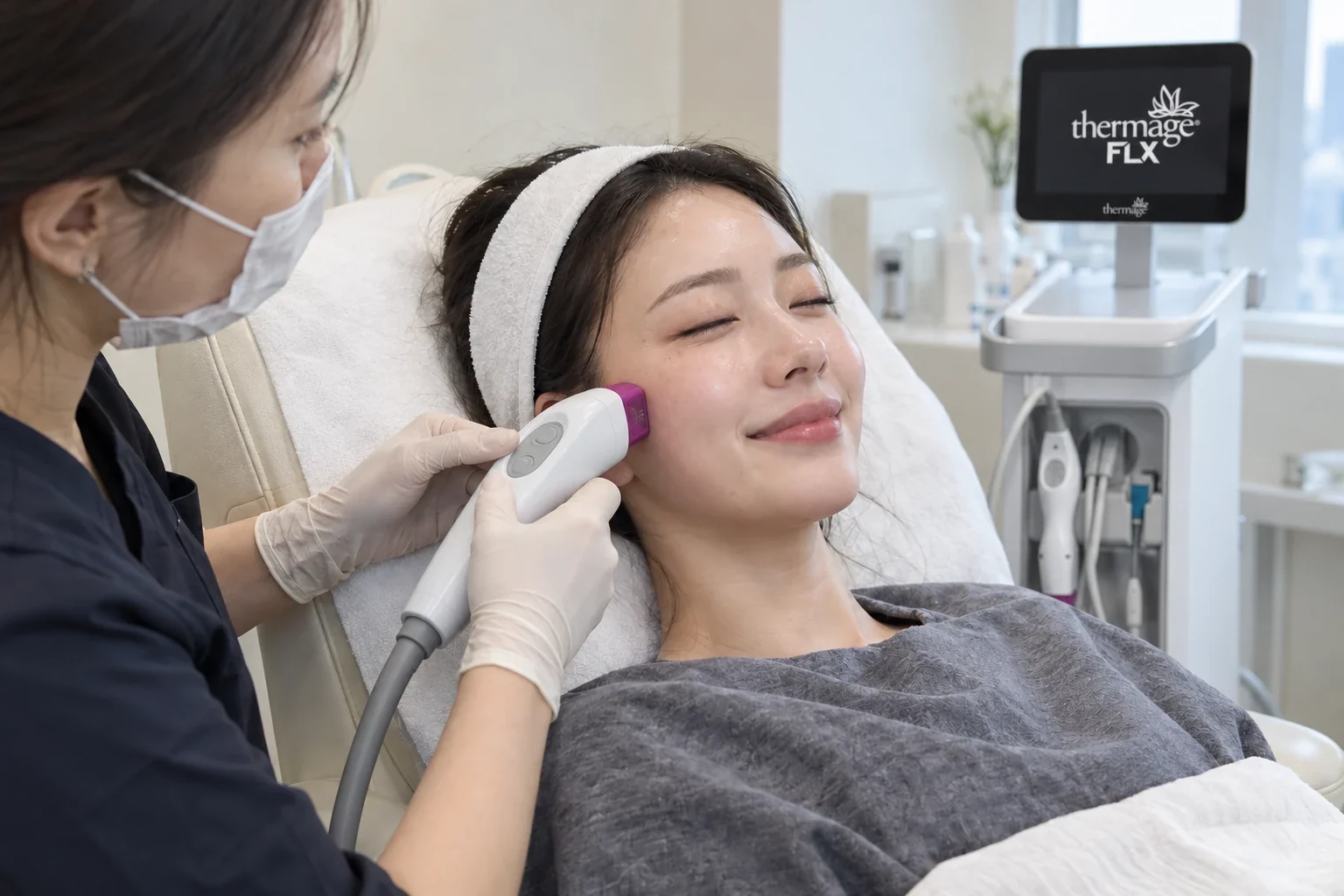
- Adjusting intensity: if the heat is strong, tell us on the spot. The intensity can be lowered or the way the passes are made can be changed.
- Cooling: with every shot, a cooling spray cools the skin surface. It is for surface protection and does not block heat in deeper layers.
- Vibration: the manufacturer explains that vibration helps comfort during treatment. However, it warns that vibration must not be used around the eyes when eye shields are in place.
- Numbing cream: in a 2025 upper-eyelid study of 14 Asian patients, numbing cream was applied 30 minutes before treatment. Whether it is needed is decided based on the area and your sensitivity to pain.
Blocking pain too much can make it harder to notice overheating. If one spot feels unusually hot or stinging during treatment, telling us right away instead of enduring it is important for preventing burns.
Side effects that can occur after treatment
Dividing the reactions in the manufacturer's safety information into common and rare gives the following.
| Reaction | Course stated by the manufacturer | Contact us when |
|---|---|---|
| Redness | Usually settles within 24 hours | It gets worse, or blisters or pain appear with it |
| Swelling | Usually settles within 5 days and can last up to several weeks | Only one side is severe, or pain increases |
| Burns, blisters, scabs | Rare. Possibility of scarring | Immediately if you see a blister |
| Skin surface irregularities | May be visible for 1 month or more after treatment | Unevenness lasts a long time |
| Numbness, tingling, temporary paralysis | Usually brief, but up to several weeks | Your facial movements have changed |
| Lumps under the skin | Mainly on the neck, usually settle within 1–2 weeks | They grow or hurt |
| Darkening of the skin | Usually recovers within a few months | It keeps getting darker |
The information for healthcare professionals also lists blanching, hives, bruising, and rarely recurrence of herpes around the mouth or on the genitals as reported reactions.
How rare are burns?
Burns are rare, but they are a reported side effect. In a 2003 study of 86 people treated around the eyes with an earlier-generation device (ThermaCool TC), second-degree burns occurred in 21 of 5,858 radiofrequency applications (0.36%), and after 6 months 3 people had small scars. The device generation and technique differ from today's, but the study shows why it matters to report heat right away and adjust the energy during treatment.
Can my cheeks look hollow after treatment?
The manufacturer's safety information lists "skin surface irregularities" and "lumps", and has no separate item about loss of cheek fat. If the face looks slimmer after treatment, we need to consider together whether swelling has gone down, whether body weight has changed, or whether volume was already decreasing. For people who naturally have little facial fat or already hollow cheeks, we record the volume status before treatment and plan, for example, a lower density in areas that should be preserved.
Recovery time and return to daily life
The manufacturer states that there is almost no downtime, most people return to daily life straight away, and no special care is needed beyond basic moisturizing and sun protection. However, a short downtime does not mean that side effects cannot occur.
- Cleansing and makeup: usually possible right away if the skin has no wounds, but on days when redness and warmth remain, avoid exfoliation and harsh cosmetics.
- Exercise and saunas: while there is warmth or swelling, it is better to postpone activities that raise body temperature a lot.
- Flying: the treatment itself does not prevent flying, but it is safer to leave time to check for reactions such as blisters or marked swelling before departure.
When do results appear, and how long do they last?
The manufacturer explains that some people feel tightening right away, but measurable results appear gradually over 2–6 months after a single treatment session and can last 1–2 years depending on skin condition and the aging process. In the 2003 study, too, both early tightening right after treatment and further changes following a later wound-healing response were observed. The tautness right after treatment includes swelling, so results are most accurately compared a few months later under the same lighting and angle.
What to check before treatment
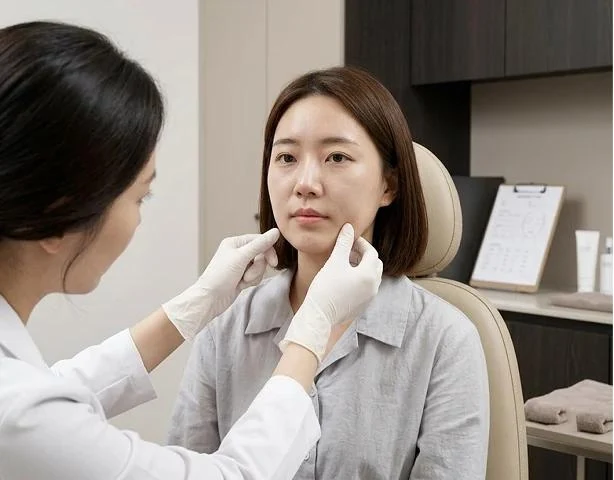
- Implanted electrical devices: if you have an electrical implant such as a pacemaker or defibrillator, treatment cannot be done (manufacturer's contraindication).
- Fillers: when treating over areas with filler (lips, cheeks, wrinkles, skin folds), the treatment area is adjusted separately. Please tell us when, where and what was injected.
- Pregnancy and breastfeeding, diabetes, autoimmune diseases such as lupus, cold sores and genital herpes, epilepsy, semi-permanent makeup or tattoos in the treatment area: if any of these apply, please tell the medical team before treatment. Whether to treat is decided separately.
- Eyelid treatment: when the eyelids and the area inside the orbital rim are treated, plastic, not metal, eye shields must be used.
- Any recent thread lift, laser or other energy-based treatment, and the dates
- Skin thickness and volume: if volume loss is the main concern, radiofrequency alone may not give the change you want.
Why check the tip?
Thermage FLX is performed with a single-use tip attached to the handpiece. According to the manufacturer, tips are designed to deliver only a set number of pulses (shots), and once used up on one person they cannot be reused. Tips include face tips (Total Tip 3.0 and 4.0cm²), an eyelid and eye-area tip (Eye Tip 0.25cm²) and a body tip (16.0cm²), and the tip that suits the area is used. Before treatment, you can ask to be shown the tip box with its type and number of shots.
A genuine tip is the basic condition; energy settings, adjustment for each area and checking the response during treatment matter just as much for results and safety.
What is the difference between 300 and 600 shots?

A shot is one contact of the tip with the skin to deliver radiofrequency. A larger number of shots means a wider area can be treated or the same area can be passed over more times; it does not mean the result grows by that much. In the survey of physicians in Korea, 86.5% of Thermage FLX users preferred the 600-shot Total Tip 4.0. The number of shots is decided by whether it is the full face or part of it, whether the eye area is included, and how thick the skin is.
At QD Clinic
At QD Clinic, we decide the treatment area and number of shots after an examination and draw a grid on the face before treatment. If it becomes too hot to bear during treatment, we lower the intensity, because forcing the intensity up increases the risk of burns. Full-face Thermage consists of 600 Thermage shots and 225 Eye Thermage shots, and we lower the density where volume should be preserved, such as the cheekbones and cheeks. Eye Thermage uses the eye-area tip, and the face tip is not used as is over the eyes. If you have an implanted electrical device, we do not perform the treatment.
Frequently asked questions
How long does the treatment take?
According to the manufacturer, 30–60 minutes depending on the area. Time for consultation, grid marking and finishing is separate.
Is it suitable for Asian skin?
There is a survey of physicians in Korea and an eyelid radiofrequency study in Asian patients (14 people, no adverse events). If your skin tends to develop pigmentation or has recently been heavily tanned, please tell us before treatment. The energy and treatment area are set according to your skin condition.
What should I do if a blister forms after treatment?
Do not pop or squeeze it; contact the clinic where you had the treatment straight away. If wound care for a burn is delayed, scarring or pigment changes may remain.
My face feels numb, or one corner of my mouth moves less
The manufacturer states that numbness, tingling and temporary paralysis usually pass quickly but can last up to several weeks. If your facial movements have changed, do not wait; see a doctor to have the course checked.
Can I have it on the same day as another treatment?
There are combinations with Ultherapy PRIME, but because more tissue receives heat, we divide the areas and check the response in overlapping zones. If you recently had another energy-based treatment or skin irritation, we adjust the order and interval.
How often should it be repeated?
The manufacturer notes that some people have it every year to maintain results, and in the survey of physicians in Korea a 1-year interval was also the most common (51.9%). The schedule, however, is decided by looking at your progress.
References
- Solta Medical, Thermage FLX official website (indications, important safety information, FAQ). https://www.thermage.com/
- Solta Medical, Thermage FLX information for healthcare professionals (tips, AccuREP, warnings, adverse events). https://www.thermage.com/hcp/
- Fitzpatrick R et al. Lasers in Surgery and Medicine, 2003;33(4) (multicenter study of radiofrequency around the eyes). https://europepmc.org/article/MED/14571447
- Dover JS, Zelickson B et al. Dermatologic Surgery, 2007 (survey of 5,700 treatments). https://europepmc.org/article/MED/17661932
- Suh DH et al. Dermatologic Therapy, 2020 (Thermage FLX survey of dermatology physicians in Korea). https://europepmc.org/article/MED/32902088
- Suh DH et al. Lasers in Medical Science, 2025 (radiofrequency study of the eyelids in Asian patients). https://europepmc.org/article/MED/41402632