
qd story
Why Sculptra Should Not Be Injected Like Filler: HA vs PLLA, Nodules
Published: 2026-10-02
Sculptra is not a product in which injected gel creates volume on the spot, as hyaluronic acid (HA) filler does. Microparticles of poly-L-lactic acid (PLLA) are placed in the deep layers of the skin to prompt the body's tissue response, and the result appears gradually over several weeks. That is why trying to fill a hollow completely in one go, as with HA filler, increases the risk of overcorrection and nodules (lumps you can feel), and the U.S. instructions for use also state that at each session you should undercorrect, wait and then reassess.
At a glance
- Sculptra is a PLLA injectable from Galderma; the vial comes as a powder (freeze-dried) and is reconstituted with sterile water for injection before treatment.
- The fullness seen right after treatment comes from the injected water and swelling; it goes down within hours to days, and the real improvement appears over several weeks.
- The U.S. label sets one treatment course at up to 4 sessions 3–4 weeks apart, and warns against overcorrecting at each session.
- It is not injected into the red part of the lips (vermilion), and an increased risk of nodules has been reported after injection around the eyes.
- Unlike HA filler, it is not an ingredient that can be dissolved and reversed with hyaluronidase.
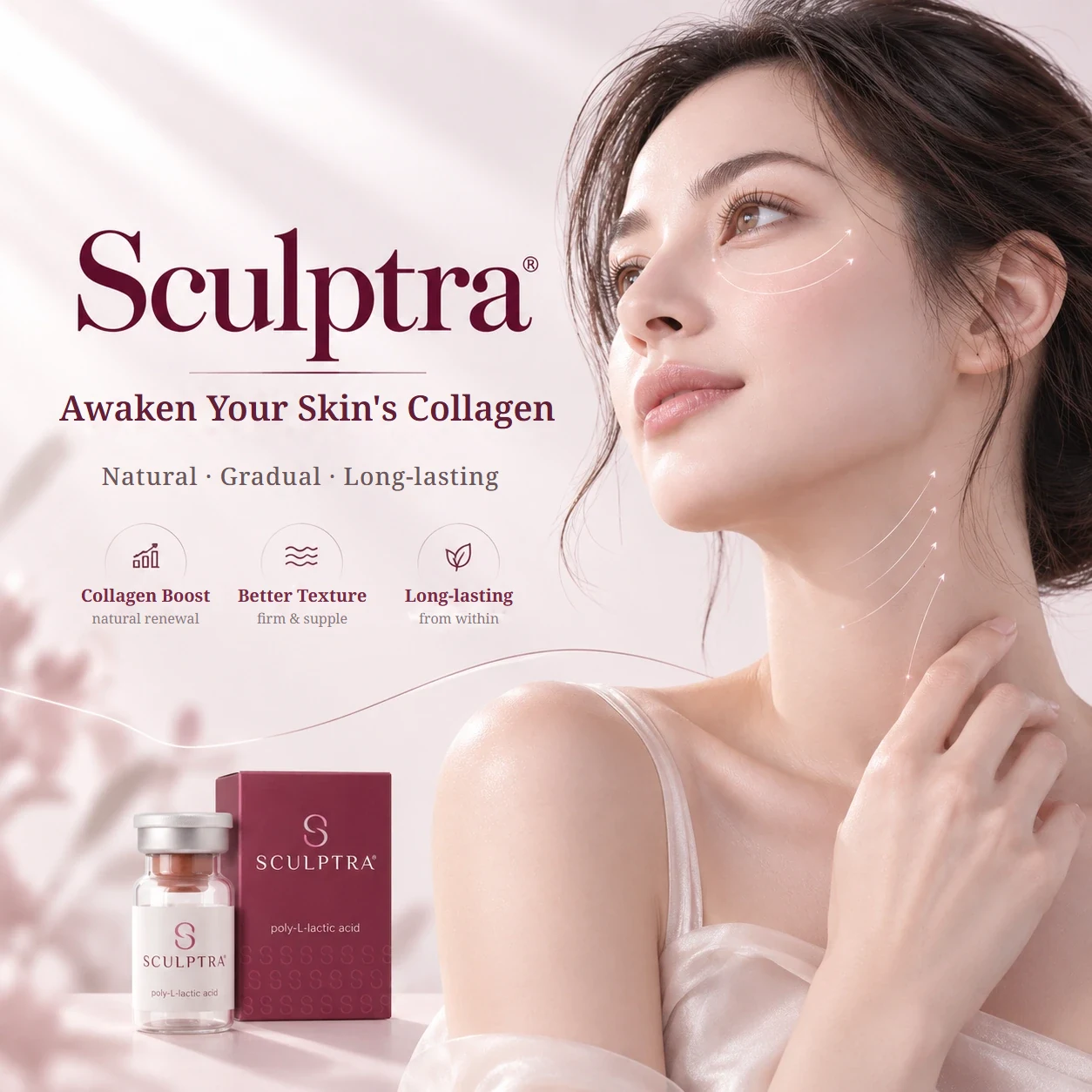
What kind of product is Sculptra?
Sculptra is an injectable implant made of PLLA microparticles, sodium carboxymethylcellulose and mannitol. One vial contains 367.5mg and is reconstituted with sterile water for injection into a suspension before use (U.S. FDA-approved label). There are three approved uses in the U.S.
- Correction of shallow to deep nasolabial folds and other facial wrinkles in immunocompetent adults
- Correction of fine lines in the cheek area
- Restoration and correction of facial fat loss (lipoatrophy) in people with HIV
The U.S. FDA's information on fillers describes PLLA as "a biodegradable, biocompatible synthetic polymer", a long-lasting material that is injected in several sessions over a few months, and states that its effect can last up to 2 years.
How is it different from HA filler?
The biggest difference is when and how volume appears. With HA filler, the injected gel itself fills the area, so the shape is visible as soon as treatment ends. Sculptra, in the words of the instructions for use, is a product with which, "unlike other wrinkle fillers, the depressed area gradually improves over several weeks". The volume right after treatment is the water used for reconstitution plus swelling from the injections, so the instructions for use say patients should be told in advance that this disappears within hours to days and the pre-treatment appearance returns.
| Item | Hyaluronic acid (HA) filler | Sculptra (PLLA) |
|---|---|---|
| Main ingredient | Cross-linked hyaluronic acid gel | PLLA microparticles (reconstituted with water before use) |
| When the shape shows | Right after treatment | Immediate swelling goes down, then gradually over several weeks |
| How correction is done | Filled to the desired shape | Undercorrected at each session and reassessed after 3–4 weeks |
| Number of sessions | Usually 1, with top-ups if needed | Up to 4 per course (U.S. label) |
| Duration described by the U.S. FDA | About 6–12 months | Up to 2 years |
| Dissolving with an enzyme | Can be broken down with hyaluronidase | Not applicable |
The durations in the table are approximate ranges given by the U.S. FDA for each type of material, and they vary with the product, area, amount and the individual.
Why is it a problem to fill everything at once like filler?
Sculptra is a product whose effect builds up over time, so if enough is injected to look good on the day, it will be too much a few weeks later. This is exactly the first warning on the U.S. label: "Do not overcorrect (overfill) a contour deficiency because the depression should gradually improve within several weeks following treatment as the effect of Sculptra occurs."
That is why the instructions for use set the principle of "Treat, Wait, Assess". Only limited correction is made at the first session, and whether to have the next session is decided by looking again after at least 3–4 weeks. The amount per injection is also limited to 0.1–0.2mL or less per point, with 0.5–1cm between points. A maximum amount per session is also set for each area.
Why do nodules form, and how common are they?
The side effect most often discussed with Sculptra is small papules and nodules that can be felt under the skin. The U.S. label describes them as "confined to the injection site, typically palpable, asymptomatic and not visible, appearing days to months after injection and possibly persisting for a long time".
- In the controlled nasolabial fold study (116 people), nodules or papules occurred in 17.2% of the Sculptra group and 12.8% of the control group. Nodules appeared at a median of 160 days after the first treatment and lasted a median of 100 days.
- In a post-market study (867 people, followed for 3 years), nodules or papules were reported in 28.4%; by area they occurred in 27.0% for the lines below the corners of the mouth (marionette lines), 19.0% for nasolabial folds, 5.4% for cheek wrinkles and 3.6% for chin wrinkles. The label states that frequency increased when more than 2mL was injected into the marionette lines.
The instructions for use list the ways to reduce early nodules as the specified dilution and injection technique (not injecting too superficially, not overcorrecting) and massage to spread the product evenly. Most resolve on their own, but the label also states that some may need treatment such as intralesional steroid injection, subcision (releasing tissue under the skin with a needle) or excision.
Why does reconstitution (dissolving the powder) matter?
Because Sculptra is supplied as a powder, mixing it thoroughly with water into an even suspension before injection is part of the treatment. The U.S. label's 5mL reconstitution method says that after adding water, "let it stand for at least 2 hours for complete hydration, and do not shake it during this time", and that the reconstituted product should be used within 72 hours. With the 8mL reconstitution method, it is shaken to dissolve and used immediately, and 1mL of 2% lidocaine may optionally be added. Because it is a suspension in which particles settle, it should be shaken from time to time during treatment to keep it even, and needles finer than the specified gauge should not be used.
Which layer and which areas is it injected into?
Sculptra is injected into the deep dermis or below it (subcutaneous, above the periosteum). The instructions for use say superficial injection should be avoided because it may increase local side effects such as nodules and papules, and advise particular care in people with thin skin.
There are clear limits on areas. The U.S. label says not to inject into the red part of the lips (vermilion), and states that an increased risk of papules and nodules after injection around the eyes (periorbital) has been reported in the literature. Post-market reports also record that some granuloma cases requiring hospitalization were related to use under the eyes or injection into the vermilion. Purposes that require an immediate shape, such as raising the nasal bridge or bringing the chin forward, are not among Sculptra's approved uses.
What are the treatment steps and aftercare?
- Examination and medical history: the U.S. label recommends reviewing the full medical history before treatment and checking vision before and after treatment.
- Planning and marking: after removing makeup and disinfecting, the injection area is marked. A cold compress or local anesthesia may be used for pain control.
- Injection: before injecting, aspiration (checking for backflow) is done to confirm the needle is not in a vessel, and small amounts are placed using set techniques such as grid, linear or fan patterns. After every 3–4 injections, the area is massaged in circles so the product spreads evenly.
- Finishing: when treatment is complete, a moisturizer is applied and the area is massaged in circles for at least 2 minutes, and an ice pack wrapped in cloth is used to reduce swelling and bruising.
Massage at home after treatment is often called "5-5-5". The U.S. instructions for use actually contain the sentence "It is recommended to massage the treated area in circles for 5 minutes, 5 times a day, for 5 days after treatment", and the same sentence adds "as instructed by the physician". So the doctor tells you directly after treatment whether and how to massage.
Other aftercare instructions (from the patient instructions in the U.S. label) are as follows.
- For the first 24 hours, use an ice pack wrapped in cloth to reduce swelling and bruising. Redness, swelling and bruising usually settle within a few hours to 1 week, and a hematoma within about 2 weeks.
- If there are no complications, makeup can be applied after a few hours.
- Until the initial swelling and redness settle, avoid sunlight, UV lamps and very hot or cold environments.
- If symptoms get worse or last long, tell your doctor.
Side effects and when not to have it
Common reactions are swelling, tenderness, redness and bruising at the injection site. According to diaries kept for 14 days after the first treatment in the U.S. nasolabial fold study, swelling and tenderness each occurred in 81.0% and redness in 77.6%, mostly mild. Nodules and papules were described above.
A rare but important risk is vascular. The U.S. label warns that if a soft tissue filler enters a blood vessel, embolism, vascular occlusion and ischemia can occur, and that temporary or permanent visual impairment, blindness, cerebral ischemia or hemorrhage and skin necrosis have rarely been reported. If vision changes, signs of stroke, skin blanching or unusual pain occur during or just after treatment, treatment must be stopped immediately and medical care sought. Infection, hypersensitivity reactions and granulomas have also been reported.
Sculptra is not used in the following cases (U.S. label contraindications).
- Hypersensitivity to any ingredient of Sculptra
- Severe allergies such as a history of anaphylaxis, or multiple severe allergies
- A history of, or tendency to, keloids or hypertrophic scars
- When mixed with lidocaine: an allergy to lidocaine or amide-type local anesthetics
If you are pregnant or breastfeeding, under 18, have a connective tissue or bleeding disorder, or are on immunosuppressive treatment, please tell the medical team before treatment. If any of these apply, whether to proceed is judged separately. If there is inflammation or infection such as acne or a rash at the treatment site, treatment is postponed until it settles. People who have had herpes around the mouth may have a recurrence, and people taking blood-thinning medication may bruise more.
At QD Clinic
At QD Clinic, Sculptra is offered under our under-eye and eye-area treatments, and the doctor decides the treatment areas at the examination. We discuss volume problems in the surrounding face and under-eye problems separately, and for thin skin or tear troughs we also consider other methods. PLLA cannot be dissolved with an enzyme like HA and nodules can appear late, so we plan conservatively from the start and do not add more at short intervals just because an area looks hollow right now. Before your consultation, please tell us about any PLLA product or other filler you have had, any existing nodules or long-lasting swelling, and any immune-related conditions.
Frequently asked questions
My face looked full on the day of Sculptra, but a few days later it went back to how it was. Did it fail?
This is the expected course. The U.S. instructions for use explain that the volume right after treatment is due to the water used for reconstitution and swelling from the injections, and that it goes down within hours to days so that the pre-treatment appearance returns. The real improvement appears over the following weeks, so any further session is decided after looking again at least 3–4 weeks later.
Can't I reduce the number of sessions by injecting a lot at once?
This is not recommended. The U.S. label says not to overcorrect at each session and to make only limited correction, and in the post-market study the frequency of nodules and papules increased when more than 2mL was injected into the marionette lines. The number of sessions is decided by individual need, and one course is set at up to 4 sessions.
Can it be dissolved if I don't like it?
Hyaluronidase, which dissolves HA filler, is an enzyme that breaks down hyaluronic acid, so it does not apply to PLLA. If nodules form, they often settle on their own, but the U.S. label states that if they persist, intralesional steroid injection, subcision or excision may be needed. That is why it is important to make a conservative plan from the start.
Can it be used for the lips or hollow under-eyes?
The U.S. label says not to inject into the red part of the lips, and states that an increased risk of nodules has been reported after injection around the eyes. For areas with thin skin and a lot of movement, such as lip volume or tear troughs, other methods are considered first.
Can Sculptra be used where I have had HA filler?
The U.S. label states that Sculptra should not be mixed directly with other fillers. For an area treated with another filler, we first check the product you had, when, and how much remains, and then decide whether to treat.
Should I mention it when having a CT or MRI?
Yes, it is best to. The U.S. label advises telling the medical staff performing imaging about the treatment, because Sculptra particles may be visible on CT, MRI, ultrasound and plain X-rays.
References
- U.S. FDA, Sculptra label (instructions for use) PMA P030050/S039, Galderma — https://www.accessdata.fda.gov/cdrh_docs/pdf3/P030050S039C.pdf
- U.S. FDA, FDA-Approved Dermal Fillers — https://www.fda.gov/medical-devices/aesthetic-cosmetic-devices/fda-approved-dermal-fillers
- Jung H, Hyaluronidase: An overview of its properties, applications, and side effects, Arch Plast Surg 2020 — https://pubmed.ncbi.nlm.nih.gov/32718106/