qd story
Rejuran Manual vs Device Injection: Pain, Depth and Results Compared
Published: 2026-10-01
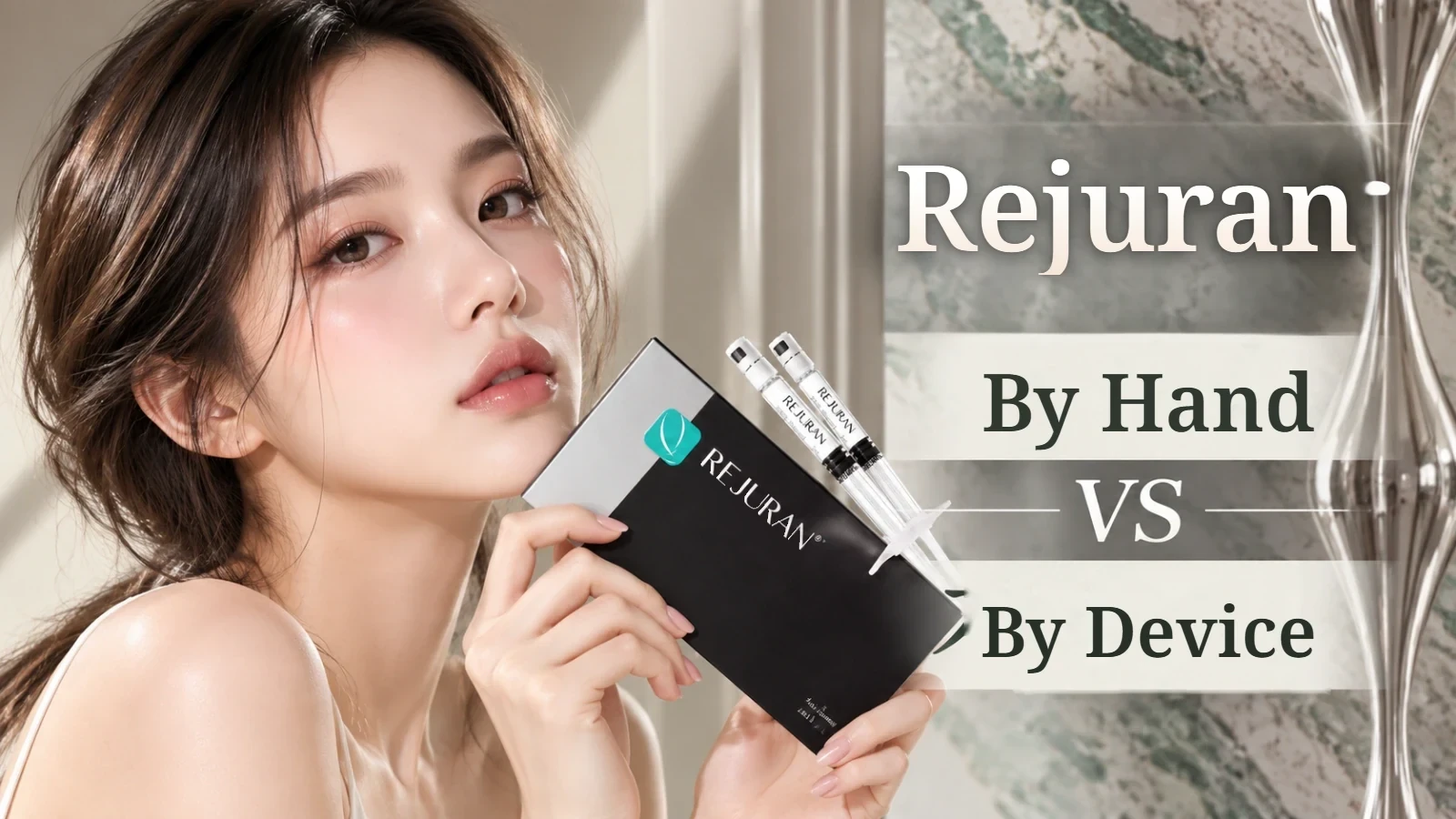
With manual Rejuran injection, the doctor injects point by point using a syringe fitted with a fine needle. With device injection, a tip with several short needles or a needle-free jet device delivers a set depth and amount over and over. In the comparison studies published so far, the device side had less pain and recovery burden or a more consistent depth, and skin improvement was reported as similar or slightly better on the device side. The two methods have different strengths, so the choice is made to suit the area and skin thickness.
At a glance
- The Rejuran instructions for use only say to "inject the solution into the skin slowly" and not to force the needle if it does not go in easily; they do not specify a single injection tool.
- In a survey of 235 Korean dermatology physicians, the most common approach was manual injection with a 33G needle, making multiple small punctures into the dermis.
- In a study of an automatic injector (31 people), the average injection depth was 0.55mm, and the dermis under the eyes was the thinnest on the face, at an average of 0.53mm.
- Studies comparing needle-free jet devices with manual injection reported less pain on the device side.
- With either method, swelling, redness, bruising and small raised bumps can occur, and the aftercare rules are the same.
What are manual injection and device injection?
Manual injection
In manual injection, a fine needle is attached to a syringe and the doctor injects point by point, controlling depth and amount by hand. A Rejuran Healer box includes 33G needles, and Rejuran i includes 34G needles (manufacturer's English instructions). In a survey of Korean dermatology physicians (Rho et al., 2024), a 33G needle and the serial puncture technique targeting the dermis were also the most commonly used. Because skin thickness differs by area, a key feature is that depth and amount can be adjusted separately for thin areas such as around the eyes and thicker areas such as the cheeks.
Device injection
"Device injection" does not mean one particular machine; there are two broad types.
- Multi-needle automatic injectors: a tip with several short needles is placed on the skin, and the device injects a set depth and amount. Some devices also use gentle suction (negative pressure) that draws the skin up slightly. One studied example is an automatic injector with 9 needles of 0.8mm.
- Needle-free jet injectors: the solution is sprayed at very high speed using a laser, pressure or cooling gas, pushing it into the skin. Laser-induced microjets, pressure jets and supersonic cryogenic jet devices have been studied.
Which hurts less?
Comparison studies generally report less pain on the device side. A split-face study of 10 people (Hong et al., 2025) reported that the pain score (VAS) on the needle-free jet injector side was clearly lower than on the needle injection side. A supersonic cryogenic jet study of 4 people (Kim et al., 2026) also reported less pain and shorter recovery than manual injection.
Pain from PN injections is also related to the formulation itself. In a study of 15 people (Jeon et al., 2026), the average pain score for a standard PN formulation was 5.04 out of 10, compared with 3.39 for a formulation with adjusted pH and ion concentration. So whichever method is used, topical anesthesia and the choice of formulation (such as Rejuran HB, which contains lidocaine) are considered together.
How do results and depth differ?
The main advantage claimed for devices is consistency of depth and amount. In an automatic injector study (Kim et al., 2025), when 2mL of PN was injected at 317 points in 31 people, the average depth was 0.55mm (standard deviation 0.13mm), with a range of 0.29–0.99mm. Dermal thickness measured in the same study was thinnest under the eyes, at an average of 0.53mm, and 1.18mm at the temples and rear cheeks. A device that injects at a constant depth is an advantage, but the study also shows that dermal thickness can differ more than twofold between areas.
The results of the effect comparisons are as follows.
| Study | Methods compared | Participants | Reported results |
|---|---|---|---|
| Hong et al., 2025 | Needle injection vs needle-free jet injector (PN) | 10 people, split-face | Lower pain on the jet side; greater improvement in overall improvement score, satisfaction, pore and wrinkle measures |
| Han et al., 2023 | Needle injection vs laser-induced microjet (PLA/HA formulation) | Randomized split-face, 24 weeks | Similar improvement in hydration and elasticity; less pain, fewer side effects and shorter treatment time on the microjet side |
| Kim et al., 2026 | Manual injection vs supersonic cryogenic jet (PN) | 4 people, 3 sessions | Similar skin improvement; less pain and shorter recovery on the jet side |
| Kim et al., 2025 | Automatic injector (0.8mm, 9 needles) alone | 31 people | Average depth 0.55mm with small variation (study measuring injection depth) |
The second study (Han et al., 2023) was carried out with a PLA/HA formulation rather than Rejuran.
How long does the effect last?
How long results last depends on age, skin condition and lifestyle, so whichever method is used, the timing of the next session is decided by following your progress after treatment. Both manual and device injection follow the same precautions in the Rejuran instructions for use.
When is each method considered?
The method is a tool chosen to fit the area and skin condition.
- Areas with thin dermis, such as under and around the eyes: the dermis is thin, around 0.5mm, so being able to adjust depth for each area matters. Whether a device that injects at a fixed depth suits this area is judged from the device specifications and an examination.
- Wide, relatively thick areas such as the cheeks and forehead: if the goal is to inject evenly over a wide area at the same depth, the consistency of a device can be an advantage.
- When pain is your biggest worry: topical anesthesia, a formulation containing lidocaine and the use of a device are compared together.
- When treating specific spots such as scars: the areas are small and depths vary, so point-by-point adjustment may be needed.
Side effects and aftercare
Whatever the method, the reactions and precautions in the Rejuran instructions for use are the same.
- Pressing on the injection site may bring on redness, swelling and erythema with itching or pain, which may last about 1 week.
- Nodules or firmness at the injection site, discoloration, or a lack of the expected effect may occur.
- Avoid makeup for 12 hours after the injection, and for 2 weeks avoid long exposure to sunlight, UV rays, cold and heat (saunas, steam rooms and the like).
- If inflammation continues for more than 1 week or an unexpected reaction appears, see a doctor quickly.
The instructions warn not to inject into blood vessels and to avoid areas where vascular occlusion and tissue necrosis could occur. The Rejuran HB instructions in particular advise against use around the eyes, such as between the eyebrows. Worsening pain, skin turning white or blotchy, or changes in vision need medical care immediately.
Use of anticoagulants, antiplatelet drugs, anti-inflammatory painkillers or immunosuppressants, autoimmune or allergic diseases, pregnancy or breastfeeding, areas recently injected with filler, and skin with inflammation or infection are contraindications in the instructions, so please tell us in advance.
At QD Clinic
QD Clinic's website describes Rejuran Healer as a treatment that places the product into the superficial dermis of the whole face with fine micro-injections. At the consultation and examination before treatment, we check the area of concern, skin thickness, previous treatments, allergies and medications; after any needed pain control and disinfection, the doctor treats each area according to its condition. One session usually takes 20–40 minutes including anesthesia time, and before you leave we explain precautions, how to contact us and the follow-up plan.
Frequently asked questions
Does device injection avoid the small bumps ("embossing")?
Even with a device, small raised bumps can form when the solution enters the dermis. Studies of needle-free jet devices reported shorter recovery, and according to the instructions for use, such reactions can last for about a week.
With the same volume, are manual and device injection equally effective?
Comparison studies have reported both similar skin improvement with the two methods and slightly greater improvement on the device side. Besides the volume, what matters for the result is whether the product was placed evenly at the right depth for each area.
Is the under-eye area safe if a device is used?
The dermis under the eyes is thin, a little over 0.5mm on average, and the area has many blood vessels, so depth and vascular risk must be judged separately whether or not a device is used. According to its instructions, Rejuran HB should not be used around the eyes.
Is numbing cream enough?
Topical anesthesia helps reduce the sting when the needle goes in, but the pressure felt as the solution goes in may remain. If you are sensitive to pain, we discuss adjusting the formulation, injection method and treatment area together.
Can I go to work the next day?
Most daily activities are possible, but swelling, redness, small bumps or bruising may show for a few days, and according to the instructions reactions may last about 1 week. If you have an important event, it is safer to allow a week or more.
References
- PharmaResearch, Rejuran / Rejuran i / Rejuran s instructions for use (Korean and English, 2024) — https://rejuran.co.kr/manual/RJR.pdf
- PharmaResearch, Rejuran HB instructions for use (2023) — https://rejuran.co.kr/manual/RHB.pdf
- Rho NK et al., "A survey on the cosmetic use of injectable polynucleotide", J Cosmet Dermatol 2024 — https://pubmed.ncbi.nlm.nih.gov/38093498/
- Kim JS et al., "Analysis of Dermal Thickness … After Polynucleotide Injection Using Rejumate Automatic 0.8-mm 9-pin Injector", Plast Reconstr Surg Glob Open 2025 — https://pubmed.ncbi.nlm.nih.gov/41000432/
- Hong JY et al., "Therapeutic Performance of Needle Injection Versus Needle-Free Jet Injector System for Polynucleotide Filler", J Cosmet Dermatol 2025 — https://pubmed.ncbi.nlm.nih.gov/39370844/
- Han HS et al., "Needleless laser injector versus needle injection for skin enhancement and rejuvenation effect of dermal filler", Lasers Surg Med 2023 — https://pubmed.ncbi.nlm.nih.gov/37632290/
- Kim M et al., "Supersonic Cryogenic Jet Delivery of Polynucleotides Compared With Manual Intradermal Injection", Plast Reconstr Surg Glob Open 2026 — https://pubmed.ncbi.nlm.nih.gov/41710189/
- Jeon W et al., "Efficacy of Ionization-Adjusted PN Filler in Minimizing Injection Pain", Aesthetic Plast Surg 2026 — https://pubmed.ncbi.nlm.nih.gov/41361144/
- Ahuja R et al., "Efficacy of Polynucleotides in Periorbital Rejuvenation: A Systematic Review", Aesthet Surg J Open Forum 2026 — https://pubmed.ncbi.nlm.nih.gov/42979324/