
qd story
PDRN vs PN: Salmon Injection vs Rejuran, Ingredients and Approval
Published: 2026-10-08
PDRN (polydeoxyribonucleotide) and PN (polynucleotide) are both ingredients obtained mainly from the DNA of fish such as salmon and trout, but their chain length (molecular weight) and their regulatory classification in Korea differ. In Korea, PDRN injections are prescription medicines approved for "treatment of wounds caused by skin grafting and tissue repair", while PN injections such as Rejuran are medical devices (biomaterials for tissue repair) approved for "temporary improvement of facial wrinkles". Rejuran is a PN product, not PDRN. The two ingredients differ in how they work and in their approved purpose, so the choice is made to suit the change you want.
At a glance
- PDRN is described as relatively short DNA fragments and PN as longer DNA chains, but even in the scientific literature the two terms have been used interchangeably.
- The main proposed action of PDRN is stimulation of the adenosine A2A receptor; for PN, formation of a water-holding support structure (scaffold) has been proposed.
- A PDRN injection in Korea (for example, Placentex Inj.) is a prescription medicine containing 5.625mg per 3mL ampoule.
- Rejuran Healer, i and S and Rejuran HB are medical devices approved by Korea's Ministry of Food and Drug Safety (MFDS).
- QD Clinic presents salmon PDRN injections and Rejuran (Healer, HB, i) as separate treatments.
What is PDRN?
PDRN stands for polydeoxyribonucleotide, an ingredient made up of purified DNA fragments. A 2025 review (Kim, Pharmaceutics) describes PDRN as a substance consisting of oligonucleotide sequences shorter than those of PN, and summarizes that it supports skin condition by activating adenosine receptors and supporting the salvage pathway of nucleic acid synthesis.
In Korea, PDRN injectables are approved as medicines. Placentex Inj., registered in the MFDS drug database (Nedrug), is a prescription medicine imported from Italy. Each ampoule (3mL) contains 5.625mg of sodium polydeoxyribonucleotide; its approved indication is "treatment of wounds caused by skin grafting and tissue repair", and its dosage is "one ampoule a day by intramuscular or subcutaneous injection".
The same product information also includes the results of Korean post-marketing surveillance. In 609 people treated for wounds and surveyed over 6 years, adverse events occurred in 0.99% (6 people, 7 cases), including itchy rash, vomiting and abdominal pain with one case each, and no serious cases were reported.
What is PN?
PN stands for polynucleotide, a long DNA chain of linked nucleotides. The same review explains that PN consists of longer DNA fragments and is involved in remodeling of the extracellular matrix. An expert-opinion paper connected with the maker of Rejuran (Rho et al., 2026) introduces PN as long-chain nucleotides made from salmon or trout DNA and proposes a mechanism in which PN forms a water-attracting, mesh-like structure that helps tissue remodeling and moisture retention.
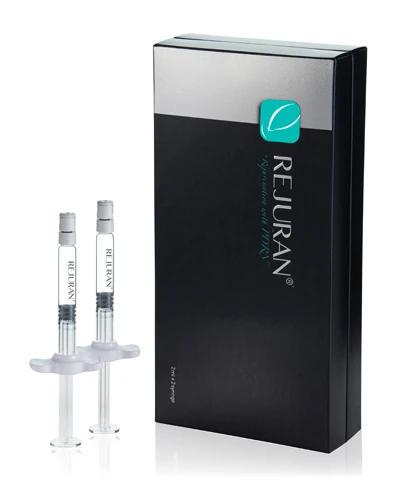
In Korea, Rejuran is a medical device. Rejuran, Rejuran i and Rejuran S have approval No. 14-825, product category "biomaterial for tissue repair", and the intended purpose "to temporarily improve facial wrinkles in adults". The ingredient is listed as "sodium polynucleotide".
How do PDRN and PN differ?
| Category | PDRN | PN |
|---|---|---|
| Full name | Polydeoxyribonucleotide | Polynucleotide |
| Chain length | Relatively short DNA fragments | Longer DNA chains |
| Main proposed action | Stimulation of adenosine receptors (A2A), support of the nucleic acid salvage pathway | Water-holding support structure, extracellular matrix remodeling |
| Regulatory classification of injectables in Korea (example) | Prescription medicine (Placentex Inj.: treatment of skin-graft wounds and tissue repair) | Medical device (Rejuran: temporary improvement of facial wrinkles) |
| Main research areas | Wound healing and tissue recovery | Randomized comparison studies on the skin around the eyes and cheeks |
"Short" and "long" in the table are relative terms. A 2025 review (Marques et al., Biomolecules) pointed out that the molecular weight of PDRN and PN usually ranges from 50 to 1,500kDa, with reports from 1kDa up to 10,000kDa depending on the study, and that confusion has arisen because papers use the two terms interchangeably. The paper proposed calling anything smaller than 1,500kDa PDRN and anything equal to or larger than that PN.
Is Rejuran a PDRN injection or a PN injection?
Rejuran is a PN injection. Because of the nickname "salmon injection" it is often presented as the same as PDRN injections, but the Korean instructions for use list its ingredient as sodium polynucleotide and its category as a biomaterial for tissue repair, which is a medical device. Even within the Rejuran line, the composition differs by product.
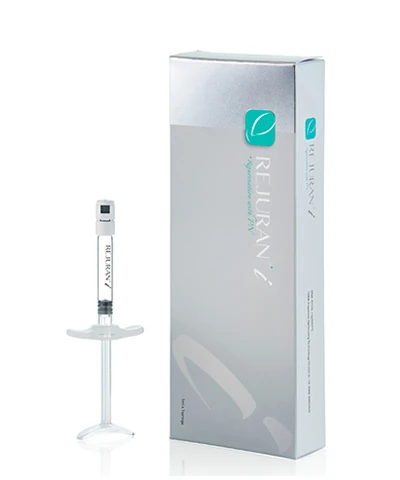
Rejuran i is a PN product under the same approval as Rejuran Healer (approval No. 14-825), and according to the manufacturer's English instructions it contains a 1mL syringe and a 34G needle. At QD Clinic it is offered as an under-eye and eye-area treatment.
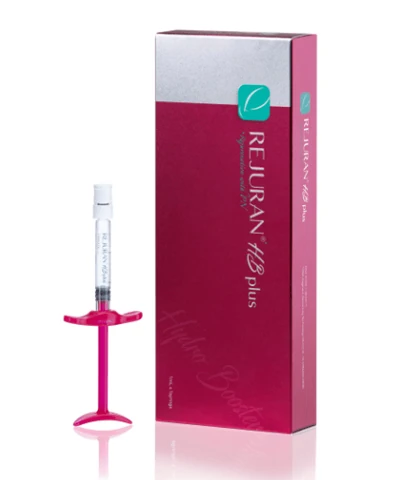
Rejuran HB is a separately approved product (approval No. 17-353); according to its instructions for use, it is a product that "injects sodium polynucleotide containing lidocaine and hyaluronic acid into the subcutaneous layer". On the manufacturer's website list it appears as "Rejuran HB Plus". The HB instructions advise against use around the eyes, such as between the eyebrows, because injection into a blood vessel could cause serious adverse events including blindness.
What results have PN injections shown in studies?
PN injections have mainly been evaluated in randomized split-face studies in Korea. Typical examples are as follows.
- In a study of 27 people who received PN on one side around the eyes and non-cross-linked hyaluronic acid on the other, 3 times at 2-week intervals (Lee et al., 2022), overall improvement scores were similar on both sides, improvement rates in elasticity, hydration, roughness and pore measures were higher on the PN side, and there were no serious adverse events.
- In a study comparing PN with a PCL filler in 30 people with crow's feet (Jeong et al., 2020), there was no significant difference in improvement after 12 weeks.
- A systematic review of 6 studies on PN around the eyes (350 people) (Ahuja et al., 2026) reported that the proportion whose crow's feet grade improved by at least 1 grade at 12 weeks was 40–70%.
PDRN has mainly been studied in the fields of tissue recovery and wound healing.
How do I choose by skin concern?
The right order is to sort out the cause of your concern before looking at ingredient names.
- Fine lines and skin texture: the most evidence has built up for PN injections. In a survey of 235 Korean dermatology physicians, the main indications for PN were, in order, fine lines on the cheeks, fine lines under and around the eyes, uneven skin texture and dry skin.
- Dryness such as tightness after washing: first check your moisturizer and cleansing habits. Injections do not need to come first.
- Deep wrinkles, hollows and sagging: neither PN nor PDRN fills volume or lifts sagging, so they are compared with fillers, lifting and similar treatments.
- Depressed scars: injections are planned together with other treatments depending on the depth and shape of the scar.
- Skin with inflammation or infection: the Rejuran instructions say not to use it on damaged skin, so this is treated first.
Side effects and when not to have it
Redness, swelling, bruising, pain and small raised bumps at the injection site are common reactions. The Rejuran instructions state that pressure may bring on redness, swelling and erythema with itching or pain lasting about 1 week, and that nodules or firmness, discoloration or a lack of effect may occur. Injection into blood vessels and areas at risk of vascular occlusion and tissue necrosis must be avoided, and worsening pain, changes in skin color or changes in vision need medical care immediately.
The contraindications in the Rejuran instructions include hypersensitivity to the ingredient, pregnancy or breastfeeding, minors, use of anticoagulants, antiplatelet drugs, anti-inflammatory painkillers or immunosuppressants, autoimmune or allergic diseases, areas recently injected with filler, and skin with inflammation or infection. PDRN injection (Placentex Inj.) is not given to people who are hypersensitive to the active ingredient or additives. If you have reacted to fish-derived ingredients or previous injections, please be sure to tell us in advance.
At QD Clinic
QD Clinic presents salmon PDRN injection (one vial of 3cc) as a hydration and skin injection treatment, Rejuran Healer and Rejuran HB as skin booster treatments, and Rejuran i as an under-eye and eye-area treatment. Rather than relying on the nickname "salmon", we first check and explain the actual product's composition and approved use, and we treat PDRN and PN as different ingredients. Before treatment we check for allergy to fish-derived ingredients, previous PN or PDRN treatments and reactions, and medications.
Frequently asked questions
Can I have salmon PDRN and Rejuran on the same day?
Injecting both into the same area can increase irritation and swelling, so whether to combine them and how to divide the areas is decided at the examination.
Is applying PDRN cosmetics similar to the injection?
Products applied to the skin and injections reach the inside of the skin in different ways, and the form and concentration of the ingredient also differ by product. So cosmetics and injections are treated as different kinds of care.
Why is PDRN a "medicine" and Rejuran a "medical device"?
The classification depends on the approved purpose and mode of action. Placentex Inj. is a prescription medicine approved for wound treatment and tissue repair, while Rejuran is a medical device approved as a biomaterial for tissue repair that is injected to temporarily improve facial wrinkles.
Can I have it if I have a fish allergy?
Both ingredients come from fish DNA, so if you have had allergic reactions to seafood or previous injections, you must tell us. According to the instructions, hypersensitivity to the ingredient is a contraindication, and the level of risk is assessed separately at the examination.
How many sessions do I need?
For PN, 3 sessions at 4-week intervals was the most common recommendation in a survey of Korean dermatology physicians. For PDRN as well, the actual number of sessions and the interval are decided at the examination based on the product and your response to the first treatment.
References
- Ministry of Food and Drug Safety, Nedrug drug database, Placentex Inj. (sodium polydeoxyribonucleotide) product information — https://nedrug.mfds.go.kr/pbp/CCBBB01/getItemDetail?itemSeq=200809246
- PharmaResearch, Rejuran / Rejuran i / Rejuran s instructions for use (Korean and English, 2024) — https://rejuran.co.kr/manual/RJR.pdf
- PharmaResearch, Rejuran HB instructions for use (2023) — https://rejuran.co.kr/manual/RHB.pdf
- PharmaResearch, official Rejuran website product list — https://www.rejuran.co.kr/
- Kim ST, "Comparison of Polynucleotide and Polydeoxyribonucleotide in Dermatology", Pharmaceutics 2025 — https://pubmed.ncbi.nlm.nih.gov/40871045/
- Marques C et al., "From Polydeoxyribonucleotides (PDRNs) to Polynucleotides (PNs)", Biomolecules 2025 — https://pubmed.ncbi.nlm.nih.gov/39858543/
- Rho NK et al., "Expert Perspectives: Evidence-Based Applications of Polynucleotides (PNs) in Aesthetic Medicine and Dermatology", Clin Cosmet Investig Dermatol 2026 — https://pmc.ncbi.nlm.nih.gov/articles/PMC13047770/
- Lee YJ et al., "Comparison of the effects of polynucleotide and hyaluronic acid fillers on periocular rejuvenation", J Dermatolog Treat 2022 — https://pubmed.ncbi.nlm.nih.gov/32248707/
- Jeong GJ et al., "A randomized, patient/evaluator-blinded, split-face study to compare polycaprolactone and polynucleotide fillers in the correction of crow’s feet", J Cosmet Dermatol 2020 — https://pubmed.ncbi.nlm.nih.gov/31680395/
- Ahuja R et al., "Efficacy of Polynucleotides in Periorbital Rejuvenation: A Systematic Review", Aesthet Surg J Open Forum 2026 — https://pubmed.ncbi.nlm.nih.gov/42979324/
- Rho NK et al., "A survey on the cosmetic use of injectable polynucleotide", J Cosmet Dermatol 2024 — https://pubmed.ncbi.nlm.nih.gov/38093498/