
qd story
Ultherapy PRIME vs Original Ultherapy: How It Works and FDA Clearance
Published: 2026-07-07
Ultherapy PRIME is a micro-focused ultrasound lifting device made by Merz Aesthetics. Without any incision, it focuses ultrasound onto single points at depths of 1.5mm, 3.0mm and 4.5mm below the skin to create small thermal coagulation points, and the tissue response over the following months gradually tightens sagging skin. The principle is the same as the original Ultherapy. The main difference is that PRIME keeps the real-time ultrasound imaging the earlier system already had and improves the screen, the imaging range and the processing speed. The U.S. FDA has cleared the device for lifting the eyebrow, lifting lax tissue under the chin and on the neck, improving lines and wrinkles of the décolleté, and other uses.
At a glance
Energy: focused ultrasound. The standard depths are 1.5mm (superficial dermis), 3.0mm (deep dermis) and 4.5mm (SMAS and platysma) (manufacturer's information).
Imaging: the DeepSEE transducer shows up to 8mm below the skin so the operator can check contact and treatment depth (U.S. FDA clearance documents).
Cleared uses: eyebrow, under the chin and neck, décolleté, and skin laxity on the abdomen and arms (knees added in 2026). The wording of the clearance describes the purpose as a "temporary" change in the appearance of the skin.
What changed with PRIME: a 35% larger screen, twice the ultrasound imaging range, and an average 20% faster platform (based on a survey of practitioners). This does not mean the results are stronger.
When changes appear: the main clinical studies assessed results about 90 days after treatment.
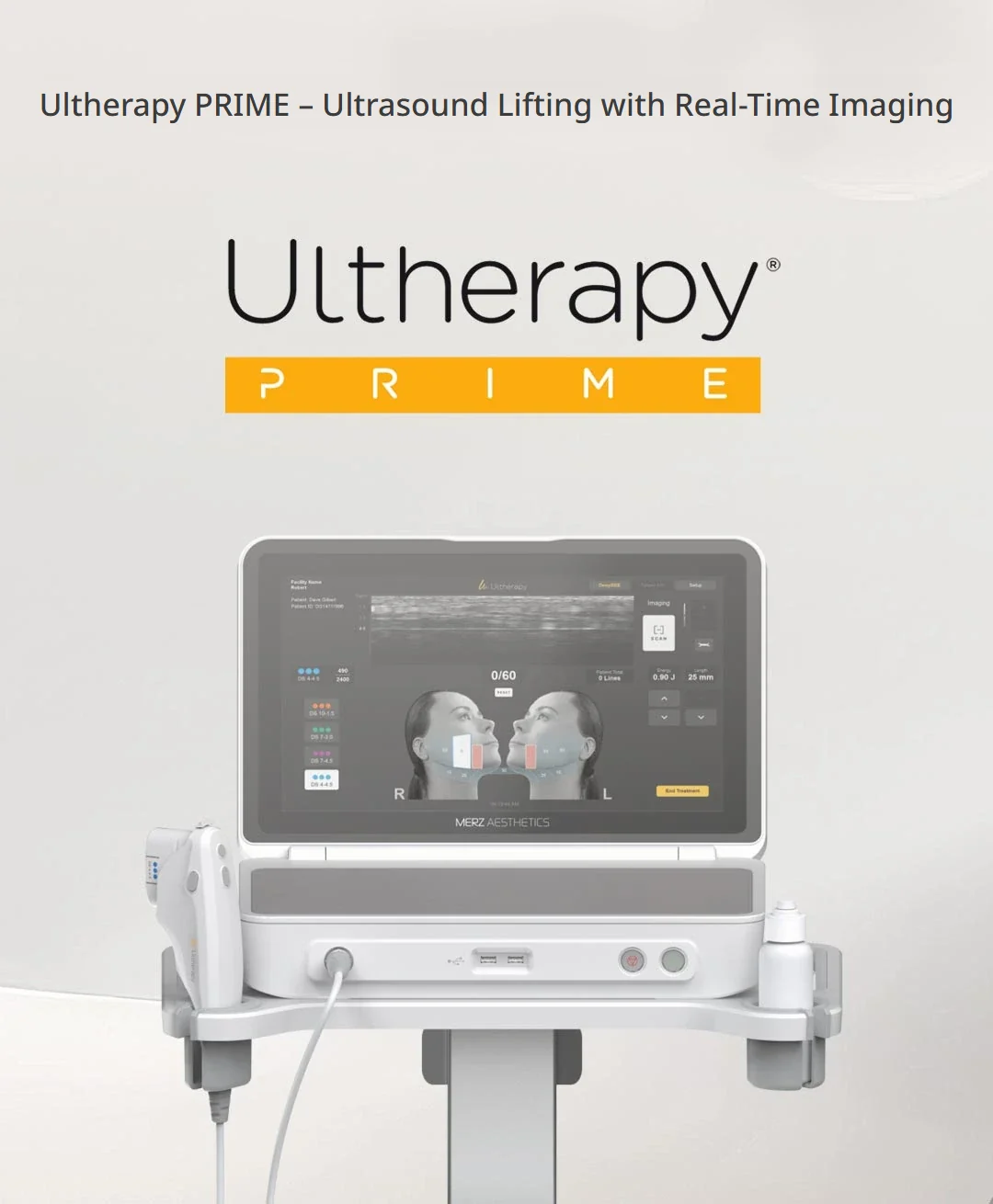
What kind of device is Ultherapy PRIME?
Ultherapy PRIME is the newest console of the Ulthera System. In the U.S. FDA classification it belongs to "focused ultrasound stimulator system for aesthetic use" (a Class 2 medical device), and it is made by Ulthera, Inc., part of the Merz group. It has three parts: the main unit (a touchscreen console), the handpiece, and interchangeable transducers.
In Korea the treatment is usually called "Ulthera" for short, and it is also called "Ultherapy" after its English treatment name. At QD Clinic, the treatment we refer to as Ultherapy is performed with this Ultherapy PRIME.
The FDA clearance documents state the purpose of the device as "temporary changes in the physical appearance of the skin." It is not a treatment that cuts away or anchors loose skin as surgery does. It is more accurate to understand it on the basis that, because ageing continues, the result also fades over time.
How does it lift sagging skin?
Ultrasound is focused onto a single point at a set depth under the skin, creating a small thermal coagulation point only at that spot. The FDA clearance summary explains that these thermal coagulation points make the skin contract, producing a lifting and tightening effect. According to the instructions for use, a single coagulation point has a volume of less than 1mm³, and the average acoustic intensity outside the focus does not change tissue. This is why it works only below the surface without separately cooling the skin surface.
After the heat stimulus, the tissue repairs itself and goes through a process in which collagen and elastin are formed again. Because this process takes time, changes appear not right after treatment but over several weeks to several months. The comparison table in Sofwave's FDA clearance document (K211483) lists the tissue temperature at the focal point of the Ulthera System, the comparison device, as 65°C.
The depth is set by the interchangeable transducer. The types listed in the instructions for use are as follows.
Transducer | Frequency | Treatment depth | Layer reached (manufacturer's description) | Maximum line length |
|---|---|---|---|---|
DS 10-1.5 | 10MHz | 1.5mm | Superficial dermis | 25mm |
DS 10-1.5N (narrow) | 10MHz | 1.5mm | Superficial dermis | 14mm |
DS 7-3.0 | 7MHz | 3.0mm | Deep dermis | 25mm |
DS 7-3.0N (narrow) | 7MHz | 3.0mm | Deep dermis | 14mm |
DS 7-4.5 | 7MHz | 4.5mm | SMAS and platysma | 25mm |
DS 4-4.5 | 4MHz | 4.5mm | SMAS and platysma | 25mm |
The SMAS layer at a depth of 4.5mm is the fascial layer that wraps the facial muscles, the same layer that is pulled and anchored in facelift surgery. Because skin thickness differs from person to person and from area to area, the actual tissue at that depth is checked on the image before treatment.
What does real-time imaging (DeepSEE) check?
DeepSEE lets the operator view the ultrasound image and treat with the same transducer. According to the FDA clearance documents, it can show up to 8mm below the skin, and the image has two purposes: to make sure the transducer is properly coupled to the skin, and to confirm an appropriate treatment depth, for example to avoid bone.
In actual treatment, the image shows where the dermis, fat layer, fascia and bone lie, and from that we decide which depth of transducer to use at each spot and which spots to skip. For example, where the skin and fat are thin and the bone is close, the deep transducer is avoided or reduced.
What changed from the original Ultherapy?
It is often said that "real-time imaging arrived with PRIME," but this is not accurate. The DeepSEE imaging function of the original Ultherapy (up to 8mm) is already described in a 2018 FDA clearance document. What changed with PRIME is imaging and processing performance. The changes stated by the manufacturer are as follows.
35% larger screen (high-resolution touchscreen)
Twice the ultrasound imaging range, faster image refresh, less noise
10 times the processing power (new dual-core processor)
Platform speed improved by an average of 20% — according to the manufacturer's footnote, this is the average of a survey of practitioners compared with the previous system.
The 2025 FDA clearance (K250418) added wireless connectivity and a treatment-planning mode called "SEE.PLAN.TREAT," and states that the ultrasound signal energy is the same as in the earlier PRIME model. In other words, the energy delivered to the skin has not become stronger or new; it is a device that makes viewing, planning and delivering the treatment easier and faster.
What is covered by the FDA clearance?
The U.S. FDA clearance wording for the Ulthera System (K250418 in 2025, K260618 in 2026) is as follows.
Lifting the eyebrow
Lifting lax tissue under the chin (submental) and on the neck
Improving lines and wrinkles of the décolleté (upper chest)
Improving the appearance of skin laxity on the abdomen, the front and back of the arms, and the knees (added in 2026)
There is also a study that evaluated improvement of laxity in the lower face (cheeks, jawline and under the chin) (Oni et al., 2014). At the examination, the doctor looks at where the sagging is and sets the treatment areas within an approved face and neck treatment plan.
Who is it suited to, and who should not have it?
It is mainly considered when the cheeks, jawline or neck area have begun to sag mildly to moderately and you want to manage this without surgery. If sagging is advanced, the change may be smaller than expected, so we also look at whether surgery would suit your condition better. In a lower-face study (Oni et al., 2014), 54.5% of patients with a body mass index (BMI) over 30 were rated as having no change, a weaker response than in those with a BMI of 30 or less (12.2%).
The contraindications set out in the manufacturer's instructions for use are as follows.
Open wounds or lesions in the treatment area
Severe or cystic acne in the treatment area
Active implanted devices such as pacemakers or defibrillators, or metal implants in the treatment area
Some situations are not contraindications but call for caution. Treatment directly over fillers or mechanical implants, or over keloids, is not recommended. The thyroid, large blood vessels and nerves, and the area inside the eyes, eyelids and orbital rim are kept out of the treatment area. If you are pregnant or breastfeeding, are taking anticoagulants, or have a bleeding disorder, a skin condition that slows wound healing, herpes simplex, an autoimmune disease, diabetes, epilepsy or Bell's palsy, please tell the medical team before treatment. If any of these applies, whether to treat is decided separately.
How is the treatment done, and how long does it take?
At QD Clinic the treatment proceeds in this order: consultation and skin assessment → cleansing and marking of the treatment area → ultrasound delivery by depth and area → soothing care and aftercare instructions. A full face usually takes about 40–60 minutes.
Each time energy is delivered you feel a short, deep prickling sensation. In the lower-face study, pain scores during treatment were reported as 5.68 for the cheeks, 6.09 for the submental area (under the chin) and 6.53 for the submandibular area (under the jawbone), out of 10. If you are worried about pain, let us know in advance; we prepare pain relief and adjust the strength and pace of the shots.
What are the recovery time and side effects?
Most people return to daily life the same day, but it is not a treatment with no reaction at all. The reactions and their duration in the face and neck clinical trials summarised in the instructions for use are as follows.
Redness: right after treatment, usually settles within a few hours
Swelling: 3–72 hours
Raised lines on the skin (welting): within 1 week
Discomfort after treatment for 2 hours to 2 days, tenderness to touch for 2 days to 2 weeks
Bruising: occasional, 2 days to 2 weeks
Temporary muscle weakness, reduced sensation, numbness: caused by nerve inflammation and usually recovers within 2–6 weeks (no permanent facial nerve damage was reported in the clinical trials)
With incorrect technique (tilting the transducer, insufficient spacing between lines, etc.), burns and scars are possible
There are also rare risks you should know about. The list of post-marketing reports in the instructions for use includes loss of fat or volume, skin sagging and asymmetry, burns and blisters, nodules, pigment changes, scars, paralysis, and nerve symptoms lasting several months. In a 2025 systematic review (19 studies, 506 people), the most common reactions were also temporary swelling, redness and pain; only one case of fat atrophy was reported in published papers, but in the FDA adverse event reporting database, fat atrophy, nerve after-effects and scars were reported frequently. For people with little facial fat, we decide even more carefully where and how many deep-layer shots to place.
If you have blisters, pain that keeps getting worse, abnormal sensation that remains after several weeks, or changes in facial expression movement, please contact the clinic rather than waiting to see how it goes.
When do results appear, and how long do they last?
You may feel a tightening sensation right after treatment, but that is not the final result. Studies usually assessed results at around 90 days.
Eyebrow: in a study of 35 people (Alam et al., 2010), 86% showed meaningful brow lift on blinded assessment at day 90, and brow height rose by an average of 1.7mm.
Lower face: in a study of 93 people (Oni et al., 2014), blinded raters found improvement in skin laxity in 58.1% at 3 months, and 65.6% of patients felt an improvement.
Décolleté: in a study of 24 people (Fabi et al., 2013), the rate of wrinkle improvement increased over time, from 46% at 90 days to 62% at 180 days.
On how long results last, the manufacturer states that they "can last 1 year or longer." In a small study of 20 people followed for up to 1 year (Werschler et al., 2016), 6 of the 14 people who could be assessed blind at 1 year were judged improved. How long results last depends on age, skin condition and lifestyle, so at QD Clinic we review the result at 2–3 months, check progress at about 6 months and decide the timing of the next session from there.
At QD Clinic
At QD Clinic (502 Gangnam-daero, Gangnam-gu, Seoul, a 4-minute walk from Exit 3 of Nonhyeon / Sinnonhyeon Station), before Ultherapy PRIME treatment we first assess your skin, look at where the sagging is and how thick the skin and fat are, and then decide the treatment areas and the number of shots. In areas with little volume that could become hollow, deep shots are reduced or avoided. When sagging and loss of skin elasticity occur together, we also consider a combination plan that divides the areas with Thermage FLX or ONDA lifting.
Frequently asked questions
Are Ultherapy and Ultherapy PRIME different treatments?
They are the same focused ultrasound lifting. Ultherapy PRIME is the newest console of the Ulthera System, and the transducer depths (1.5, 3.0 and 4.5mm) are the same. Ultherapy at QD Clinic is performed with Ultherapy PRIME.
Are the results stronger with PRIME?
What changed with PRIME is the screen, the imaging range and the processing speed; according to the FDA documents, the ultrasound energy delivered to the skin is the same as in the previous model. The result depends on how precisely the energy is placed in which layer, and on your skin condition.
Can I wear makeup or go to work right after treatment?
Most people return to daily life the same day. Redness usually lasts a few hours, swelling can last up to about 3 days, and tenderness to touch can remain for up to 2 weeks. If you have an important event, it is safer to leave a few days to spare.
I am worried my face will look hollow.
Post-marketing reports and the literature include cases of fat and volume loss, so it is a real risk that must be considered. For faces with little fat, or areas where the cheeks are already hollow, we check the thickness on the image and plan by reducing or avoiding deep-layer shots. If you have experienced hollowing of the cheeks before, please tell us in advance.
Can I have it if I have had fillers or thread lifting?
The instructions for use do not recommend treating directly over filler. If you tell us the product used, the area and the timing, we plan by avoiding those spots or adjusting the timing.
Is one treatment enough?
Most studies and the manufacturer's guidance are based on a single treatment session. The timing of any repeat treatment is decided by looking at your age, skin condition and the change after the first treatment.
References
U.S. FDA, 510(k) K250418 Ulthera System (UC-1 Control Unit PRIME Model 2.1), clearance letter and summary, 2025. https://www.accessdata.fda.gov/cdrh_docs/pdf25/K250418.pdf
U.S. FDA, 510(k) K260618 Ulthera System (Expanded Indications), clearance letter and summary, 2026. https://www.accessdata.fda.gov/cdrh_docs/pdf26/K260618.pdf
Merz Aesthetics (Ulthera, Inc.), Ultherapy PRIME Instructions for Use. https://merzaesthetics.com/app/uploads/2025/11/ultherapy-prime-instructions-for-use.pdf
Merz Aesthetics, Ultherapy PRIME page for physicians. https://ultherapy.com/physicians-the-gold-standard
Merz Aesthetics, How Ultherapy PRIME works (consumer information). https://ultherapy.com/how-ultrasound-skin-lifting-works
U.S. FDA, 510(k) K211483 SofWave System, clearance letter and summary, 2021. https://www.accessdata.fda.gov/cdrh_docs/pdf21/K211483.pdf
Alam M, et al. Ultrasound tightening of facial and neck skin: a rater-blinded prospective cohort study. J Am Acad Dermatol. 2010;62(2):262-9. https://pubmed.ncbi.nlm.nih.gov/20115948/
Oni G, et al. Evaluation of a microfocused ultrasound system for improving skin laxity and tightening in the lower face. Aesthet Surg J. 2014;34(7):1099-110. https://pubmed.ncbi.nlm.nih.gov/24990884/
Fabi SG, et al. Evaluation of microfocused ultrasound with visualization for lifting, tightening, and wrinkle reduction of the décolletage. J Am Acad Dermatol. 2013;69(6):965-71. https://pubmed.ncbi.nlm.nih.gov/24054759/
Werschler WP, Werschler PS. Long-term efficacy of micro-focused ultrasound with visualization for lifting and tightening lax facial and neck skin. J Clin Aesthet Dermatol. 2016;9(2):27-33. https://pubmed.ncbi.nlm.nih.gov/27047630/
Humphrey VS, et al. Microfocused ultrasound with visualization: a systematic review of adverse events and risk of subsequent facelift compromise. Dermatol Surg. 2025;51(4):424-429. https://pubmed.ncbi.nlm.nih.gov/39625163/