
qd story
Radiesse in Gangnam, Seoul: CaHA Collagen Biostimulator for Natural Volume, Firmness, and Skin Quality
تاريخ النشر: 2026-09-09
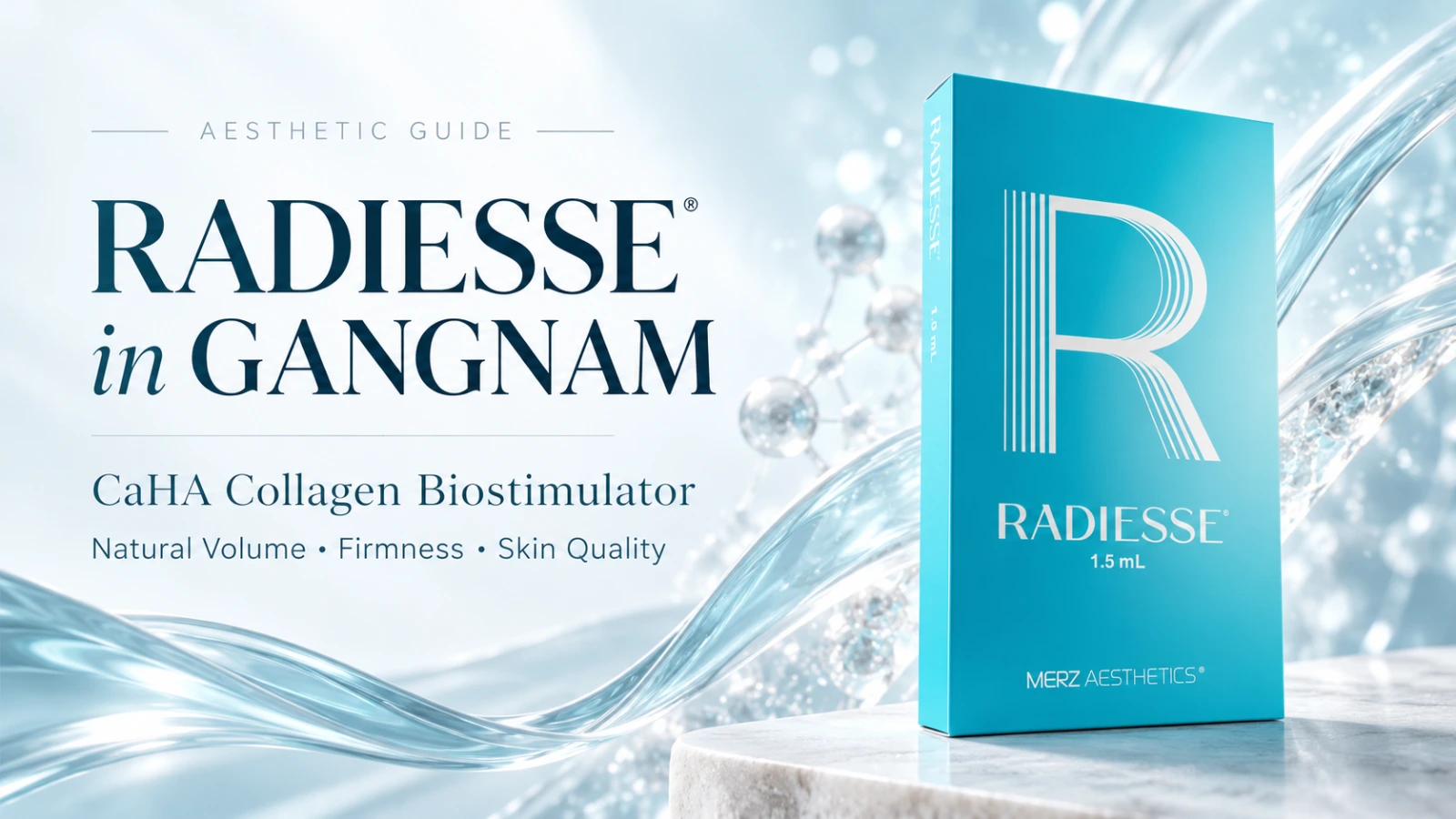
Radiesse is often introduced as a dermal filler, but its role in aesthetic treatment goes beyond simply adding volume.
Its main component, calcium hydroxylapatite (CaHA), can provide structural support while also stimulating collagen and other extracellular matrix components over time. Depending on the injection technique and dilution, Radiesse may be used for facial contouring, skin firmness, neck and hand rejuvenation, and overall skin quality improvement.
For patients looking for a more gradual, natural-looking approach to facial aging, Radiesse may be considered as a collagen biostimulator rather than simply a “filler.”
Radiesse was first approved by the U.S. FDA in 2006 for the correction of moderate to severe facial wrinkles and folds, including nasolabial folds.
Q1. What Is Radiesse?
Radiesse is an injectable product made with calcium hydroxylapatite, or CaHA, microspheres suspended in a gel carrier.
Its formulation is commonly described as approximately:
- 30% CaHA microspheres
- 70% carrier gel
The gel provides initial support after injection, while the CaHA microspheres remain in the tissue and can stimulate a regenerative response.
This is what makes Radiesse different from conventional hyaluronic acid fillers.
Rather than relying only on the injected material itself, Radiesse can also encourage the skin and soft tissue to produce new structural components over time.
Q2. How Does Radiesse Stimulate Collagen?
CaHA microspheres interact with the surrounding tissue and fibroblasts, contributing to remodeling of the extracellular matrix.
Research has reported increased production of:
- Type I collagen
- Type III collagen
- Elastin
- Other extracellular matrix components
This is why Radiesse is often described as a collagen biostimulator or regenerative injectable.
The official Radiesse professional site also describes the product as promoting regeneration and improving skin structure through extracellular matrix activity.
Rather than producing a dramatic change all at once, the collagen-related component of the result develops gradually.
Q3. Is Radiesse a Filler or a Biostimulator?
It can function as both, depending on how it is used.
Undiluted Radiesse
When used without significant dilution, Radiesse can provide structural support and volume in selected areas.
This approach may be considered for concerns such as:
- Facial contour loss
- Jawline definition
- Lower-face support
- Volume loss in selected areas
- Diluted or Hyperdiluted Radiesse
When Radiesse is diluted or hyperdiluted, the goal shifts away from adding volume and toward skin quality, firmness, and biostimulation.
Hyperdiluted CaHA has been studied for areas including the face, neck, décolletage, and hands, with research reporting improvements in laxity, skin thickness, and firmness.
The appropriate concentration and injection technique depend on the treatment area and goal.
Q4. Who May Consider Radiesse?
Radiesse may be considered for patients who are more interested in gradual structural improvement than obvious filler-like volume.
For example:
- Facial volume has gradually decreased with age
- The jawline looks less defined than before
- Skin firmness and elasticity have decreased
- The neck or décolletage has developed fine lines or crepey texture
- The backs of the hands look thinner or more aged
- HA filler feels too volumizing or “puffy” for the desired result
- A more natural aging or “well-aging” approach is preferred
However, treatment planning is different for every area.
Someone looking for facial volume restoration may need a different Radiesse technique from someone seeking skin quality improvement on the neck or hands.
Q5. What Makes Radiesse Different From Other Collagen Biostimulators?
One of the key differences is the material itself.
CaHA is a biocompatible material with a composition similar to the mineral component found in human bone and teeth.
This does not mean that the body simply treats injected CaHA as if it were its own tissue, but CaHA has a long history of medical and aesthetic use.
Radiesse has also been available for approximately two decades, with FDA approval dating back to 2006.
Another important feature is that CaHA does not appear to work only through collagen formation.
Studies have also reported changes involving elastin, extracellular matrix remodeling, and angiogenesis-related markers, although the clinical significance and strength of evidence vary between studies.
For patients, the practical point is simpler:
Radiesse is designed not only to fill space, but also to support gradual improvement in tissue quality.
Q6. Can Radiesse Be Used for the Neck and Hands?
Yes, depending on the treatment technique and local indication.
Hyperdiluted Radiesse is frequently discussed in aesthetic literature for neck rejuvenation and skin quality improvement.
A clinical study of hyperdiluted CaHA for the neck reported improvements in neck lines, laxity, and dermal thickness after treatment.
Radiesse is also widely used for hand rejuvenation, where it may help improve the appearance of age-related volume loss and skin quality.
For areas such as the neck, décolletage, and hands, diluted or hyperdiluted techniques are often used when the main goal is biostimulation rather than obvious volume.
Q7. How Long Does Radiesse Last?
The duration of Radiesse varies depending on:
- Treatment area
- Injection technique
- Dilution ratio
- Amount used
- Degree of volume loss or laxity
- Individual metabolism
The initial gel component changes over time, while the collagen-stimulating effect develops more gradually.
The official Radiesse professional site notes that results may last up to two years, although individual results vary.
Rather than treating every patient on the same schedule, maintenance is usually planned according to the area treated and how the tissue responds over time.
Q8. What Are the Possible Side Effects of Radiesse?
Because Radiesse is an injectable treatment, temporary reactions may occur.
These can include:
- Swelling
- Bruising
- Redness
- Tenderness
- Firmness or temporary irregularity at the injection site
Nodules can occur, particularly if the product is placed too superficially or used with an inappropriate technique for the treatment area.
This is why injection depth, dilution, volume, and anatomical knowledge are important.
Post-treatment massage is not automatically required for every Radiesse treatment. Whether massage is recommended depends on the injection technique and treatment area, so patients should follow their provider’s instructions.
Radiesse in Gangnam, Seoul: Is It Right for You?
Radiesse is not simply about making the face look fuller.
Depending on how it is prepared and injected, it can be used for volume support, contouring, collagen stimulation, skin firmness, and overall skin quality.
If your main concerns are gradual volume loss, reduced elasticity, early laxity, jawline definition, neck lines, or aging of the hands, Radiesse may be one option to discuss.
At QD Clinic in Gangnam, Seoul, treatment planning is based on facial structure, skin thickness, degree of volume loss, elasticity, and the area being treated.
The goal is not to add as much volume as possible, but to choose the appropriate technique for a natural-looking result that fits the patient’s facial structure and aging pattern.
This article is intended for general informational purposes and does not replace an in-person medical consultation. Treatment suitability, injection technique, recovery, and results may vary between individuals.