
qd story
GOURI vs HILO WAVE in Gangnam: Collagen Biostimulator vs Dual-HA Skin Booster
تاريخ النشر: 2026-09-08
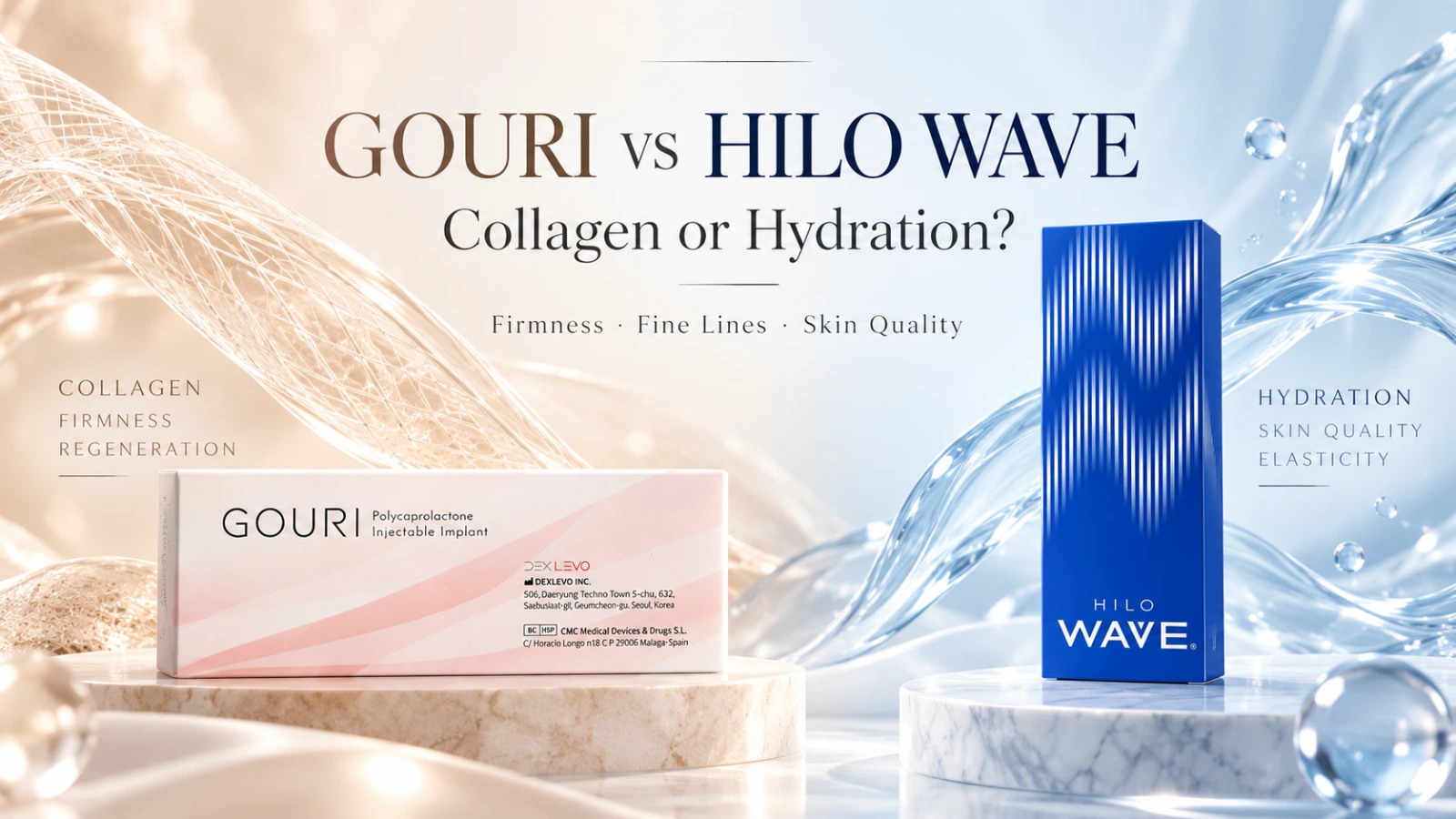
GOURI and HILO WAVE are both injectable treatments used to improve overall skin quality, but they are designed around very different treatment concepts.
HILO WAVE focuses on hydration and skin conditioning through dual hyaluronic acid (HA), while GOURI uses polycaprolactone (PCL) to support gradual collagen remodeling.
For patients visiting Gangnam, Korea, the better option depends less on which product is “stronger” and more on what the skin actually needs: hydration, fine-line care, firmness, or structural support.
Q1. What Is HILO WAVE?
HILO WAVE is a hyaluronic acid–based injectable skin treatment designed to improve facial skin condition and temporarily improve facial wrinkles.
Its key feature is a dual-HA structure, combining different molecular-weight hyaluronic acids.
Hyaluronic acid naturally attracts and holds water. When HA binds with water inside the tissue, it helps create a hydrated environment that can make the skin appear smoother and more supple.
With HILO WAVE, the two HA components have different roles:
Lower-molecular-weight HA spreads more easily through the tissue and supports hydration.
Higher-molecular-weight HA remains longer within the treated area and helps maintain a hydrated skin environment.
This makes HILO WAVE different from treatments that are primarily designed to add visible volume.
It may be considered when the main concerns are:
- Dry-looking skin
- Fine facial lines
- Rough or uneven skin texture
- Reduced hydration
- Overall skin conditioning
Q2. What Is GOURI?
GOURI is an injectable treatment based on polycaprolactone, or PCL.
Unlike hyaluronic acid fillers that are mainly used to add volume to a specific area, GOURI is generally discussed as a collagen biostimulator.
After injection, PCL-based material acts as a stimulus within the tissue, encouraging a gradual collagen remodeling response.
Rather than creating an immediate large-volume change, the goal is to support the skin and soft tissue over time.
This is why GOURI may be considered for concerns such as:
- Reduced skin firmness
- Early skin laxity
- Loss of overall elasticity
- Skin that feels less structurally supported
- Patients who prefer gradual rather than obvious volume change
Changes related to collagen remodeling develop gradually and vary between individuals.
Q3. What Is the Main Difference Between HILO WAVE and GOURI?
The easiest way to understand the difference is to look at what each treatment is designed to support.
HILO WAVE
Hydration and skin condition
HILO WAVE is centered around hyaluronic acid and water retention.
It may be more suitable when the skin feels dry, looks dehydrated, or has fine textural changes.
GOURI
Collagen remodeling and firmness
GOURI is centered around PCL and the skin’s gradual collagen response.
It may be more suitable when the main concern is reduced firmness or early laxity rather than simple dehydration.
So the difference can be summarized as:
HILO WAVE → hydration-focused skin conditioning
GOURI → collagen-focused structural support
They should not be viewed as identical treatments simply because both are injectable skin treatments.
Q4. Which Is Better for Dry Skin and Fine Lines?
If the main concern is dryness, dehydration, fine surface lines, or rough skin texture, HILO WAVE may be the more relevant option.
Because it is based on hyaluronic acid, the treatment is designed around maintaining hydration within the treated tissue.
For someone whose skin tends to:
- Feel dry easily
- Lose glow quickly
- Look rough when dehydrated
- Develop fine lines when the skin lacks moisture
a hydration-focused approach may make more sense than immediately choosing a collagen-stimulating treatment.
However, deeper wrinkles or significant volume loss usually require a different approach.
Q5. Which Is Better for Firmness and Early Skin Laxity?
If the main concern is gradual loss of firmness or elasticity, GOURI may be considered.
PCL does not function like a conventional HA filler that directly fills a hollow area.
Instead, its role is related to collagen stimulation and gradual tissue remodeling.
For this reason, GOURI may be considered when someone says:
“My skin feels less firm than before.”
“I do not want obvious facial volume.”
“I want a gradual change rather than a filler-like result.”
“My face looks slightly looser overall.”
Because collagen remodeling takes time, results are not expected to appear all at once.
Q6. How Often Are HILO WAVE and GOURI Treatments Performed?
Treatment intervals depend on the product, skin condition, treatment plan, and individual response.
For HILO WAVE, treatment is commonly planned at approximately 3- to 4-week intervals for around three sessions, followed by periodic maintenance depending on the skin condition.
For GOURI, the appropriate number of sessions and interval should be determined after assessing skin laxity, treatment area, and individual response.
Rather than following the same schedule for every patient, it is better to adjust the plan according to how the skin responds over time.
Q7. Is There Downtime After HILO WAVE or GOURI?
Both are injectable treatments, so temporary injection-related reactions can occur.
These may include:
- Redness
- Swelling
- Bruising
- Tenderness
- Small temporary bumps at injection points
The degree and duration of these reactions vary depending on the injection technique, treatment area, and individual skin response.
If you are visiting Korea for a short trip, it is important to consider upcoming photos, events, flights, and other cosmetic treatments when choosing your treatment date.
GOURI or HILO WAVE: Which One Should You Choose in Gangnam?
There is no single answer that applies to everyone.
If the main issue is dryness, hydration, fine lines, and skin texture, HILO WAVE may be considered.
If the main issue is loss of firmness, elasticity, and gradual structural support, GOURI may be more relevant.
Some patients may also have both concerns at the same time.
At QD Clinic in Gangnam, Seoul, treatment planning is based on skin hydration, fine lines, elasticity, skin thickness, and the degree of laxity rather than choosing a product based only on its name.
For international visitors, travel schedules and expected post-treatment reactions can also be considered when planning the treatment.
This article is intended for general informational purposes and does not replace an in-person medical consultation. Treatment suitability, response, recovery, and results may vary by individual.